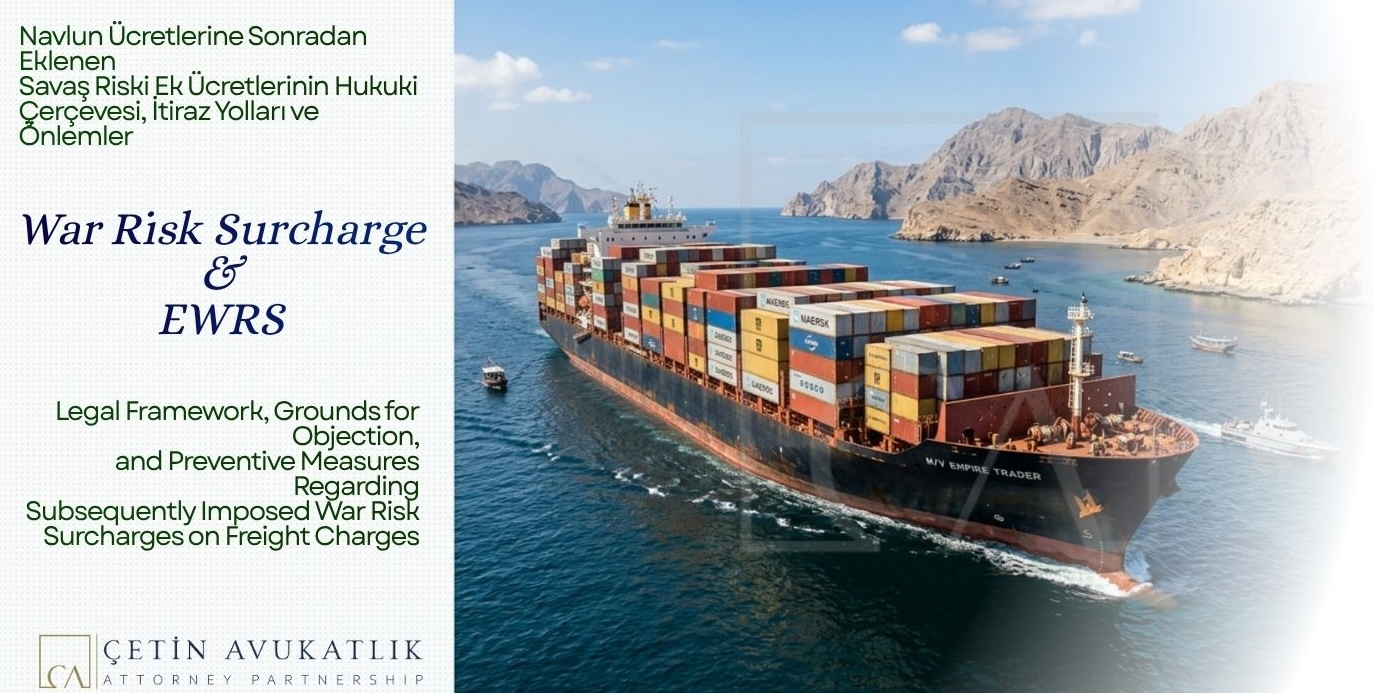
Legal Framework, Grounds for Objection and Preventive Measures Concerning Subsequently Imposed War Risk Surcharges
The War Risk Surcharge (WRS/EWRS) constitutes an additional freight component whereby the shipowner passes on to the loading party the increased insurance premium paid for vessels transiting through war zones or high-risk areas. Its legal basis is derived from the standard clauses BIMCO CONWARTIME 2004 and VOYWAR 1993, which, by incorporation into the charter party and through reference in the bill of lading, become an integral part of the contract of carriage. In export and import operations conducted from Türkiye, transit routes such as the Red Sea, the Strait of Hormuz, and the Black Sea emerge as the principal triggering regions.
In practice, it has frequently been observed that the freight quotation is approved and the shipment commences, yet the shipowner subsequently issues an additional invoice under the designation of EWRS either during or after the voyage. In such cases, it becomes necessary to establish a legal roadmap and to assess whether the obligation to pay has, in fact, arisen.
In these circumstances, the obligation to pay shall arise only where the WRS/EWRS has been explicitly stipulated in the booking confirmation, the spot rate quotation, or the bill of lading. The unilateral invoicing of an additional charge after the commencement of the shipment, where such charge is not set forth in any of the aforementioned documents, is in direct contradiction with the principles of freedom of contract and mutual assent of the parties.
Conversely, where the charter party or bill of lading expressly incorporates the CONWARTIME/VOYWAR clauses, and the relevant risk materializes after the commencement of the voyage, it may be concluded that the shipowner’s claim is supported by a legitimate legal basis. Accordingly, each dispute must be assessed on the basis of the specific contractual documentation at hand.
Where an objection is to be raised in relation to an ongoing shipment, the booking confirmation and the bill of lading must first be examined without delay in order to determine whether any clause or reference to EWRS exists. If it is concluded that the additional charge falls outside the contractual scope, a written and reasoned objection should be submitted to the shipowner or the freight forwarder. In the event that payment becomes necessary in order to secure the release of the cargo, the method of payment under protest must be duly considered, and the payment should be effected with an explicit “under protest” reservation, which must also be confirmed in writing. This approach preserves the right to reclaim the amount at a subsequent stage. Furthermore, where the transportation is arranged through a freight forwarder, it should be negotiated whether the forwarder has provided an all-in rate guarantee and whether the additional cost may be partially or fully absorbed.
The choice of delivery term likewise directly determines the allocation of such additional cost items. Under FOB delivery, the freight is organized by the buyer, and accordingly, the EWRS risk is borne by the buyer and does not directly bind the exporter. Under CIF or CFR delivery, however, as the freight is organized by the exporter, the risk remains with the exporter; nevertheless, in such cases, it is also possible to include a contractual provision in the sales agreement stipulating that increases in freight costs shall be passed on to the buyer.
Preventive measures for future shipments must be structured at the contractual stage. It should be expressly confirmed in writing that the freight quotation constitutes a final and fixed price inclusive of all surcharge items, and a duly executed booking confirmation listing each additional charge individually should be obtained. In long-term buyer relationships, a clause providing that unforeseen post-shipment increases in freight costs shall be borne by the buyer should be incorporated into the sales contract. In addition, a written undertaking should be obtained from the freight forwarder confirming that no additional surcharges will be applied.
In conclusion, claims relating to EWRS and War Risk Surcharge must first be subjected to a thorough examination of the relevant contractual documentation, and where they lack a valid legal basis, they should be challenged accordingly. For ongoing shipments, the most prudent course of action is to effect payment under protest, followed by a formal written objection. For future transactions, it must be borne in mind that the primary safeguard lies in the proper structuring of the contractual framework prior to entering into the commercial transaction.
In this context, you may contact our law firm at the e-mail address info@cetinavukatlik.com to obtain professional legal and advisory services from us regarding EWRS and war risk surcharge matters, including legal analysis specific to your concrete situation, drafting and/or review of contracts, and management of the objection process, in order to minimize risks in your current and/or future shipments, ensure correct application of contractual provisions, and prevent any loss of rights in potential disputes.
For detailed information regarding our office’s services in connection with the subject matter: