This publication considers the principal legal issues that should be addressed by a foreign investor establishing, funding, operating or acquiring a business in Turkey. It is intended as a corporate and transactional analysis. Individual investments should be assessed in light of the investor’s jurisdiction, sector, ownership structure and long term objectives.
1. The Legal Framework for Foreign Investment in Turkey
The legal framework for company formation in Turkey and foreign investment is principally established by the Foreign Direct Investment Law, the Turkish Commercial Code and the legislation applicable to the relevant sector. Under the general foreign investment regime, international investors are afforded treatment equivalent to that granted to domestic investors, subject to international agreements and special legislation. This framework allows an investment to be made through the incorporation of a new company, the acquisition of shares in an existing company, the establishment of a branch or, where commercial activity will not be conducted, the opening of a liaison office. Capital contributions may be made in cash or, where the statutory conditions are satisfied, in kind. Net profits, dividends, proceeds arising from a sale or liquidation, licence fees and payments under foreign loans may generally be transferred abroad through banks or financial institutions.
The general principle of equal treatment does not remove sector specific restrictions. Activities in banking, insurance, payment services, capital markets, energy, civil aviation, maritime transport, broadcasting, education, health and certain other regulated fields may be made subject to licences, minimum capital requirements, local establishment requirements or restrictions concerning ownership and management. A regulatory analysis should therefore be completed before the corporate purpose is drafted and before commitments are made to landlords, employees, suppliers or transaction counterparties.
2. Selecting the Appropriate Form of Market Entry
The appropriate structure is determined by the activity, duration, tax position, liability, governance and exit strategy. A subsidiary is usually selected for a lasting operational presence. A branch may be used where the parent will conduct business directly. A liaison office is confined to non commercial functions. An acquisition may be preferred where licences, contracts and operating assets must be obtained together.
A Turkish Subsidiary
A subsidiary is a separate Turkish legal entity. It may be wholly foreign owned unless special legislation provides otherwise. It holds assets, contracts and liabilities in its own name. Legal separation from the parent company permits Turkish operations to be governed, financed and reported through a distinct vehicle. It also facilitates the admission of investors and the transfer of the Turkish business. The separation is not absolute where parent guarantees, intercompany arrangements or management conduct create wider liability or tax consequences.
A Branch Office
A branch has no legal personality separate from its foreign parent. Its business must remain within the parent’s activities and its liabilities are ultimately those of the foreign company. No statutory minimum capital is generally prescribed for an ordinary branch, although an operational budget must be allocated and sectoral rules may require a particular level of funding. A fully authorised representative resident in Turkey must be appointed. The branch must be registered with the trade registry and will be subject to Turkish tax, accounting, employment and regulatory requirements in relation to its activities.
A branch may be efficient where direct participation by the foreign entity is commercially important. It may be less suitable where liability separation, local investment or a future sale is required. The tax treatment of remitted branch profits must also be compared with the taxation of subsidiary dividends.
A Liaison Office
A liaison office requires permission from the Ministry of Industry and Technology. It may not conduct commercial activity or generate income in Turkey and must be funded from abroad. Permitted functions may include market research, representation, coordination, supplier control and technical support within the approved licence. The stated function must reflect the actual activity. Where sales, invoicing or revenue generating services are undertaken, the non commercial character of the office may be challenged. An initial licence may be granted for no more than three years and extension is not automatic.
The Acquisition of an Existing Company
Shares or assets may be acquired instead of a new vehicle. Existing personnel, permits and contracts may thereby be obtained, together with historical exposure. Corporate, tax, employment, litigation, regulatory and contractual risks should be investigated through legal due diligence. Findings should be reflected in the price, closing conditions, warranties, indemnities and security. Competition clearance or sectoral approval may also be required.
Further information on transactional structuring is available in our overview of mergers and acquisitions in Turkey.
3. Limited Liability Company or Joint Stock Company
The limited liability company and joint stock company are most frequently used. Both have legal personality and may be formed by one shareholder. Their governance, transfer rules and public debt exposure differ materially.
The Limited Liability Company
A limited liability company, commonly referred to as an LLC, may have one to fifty shareholders. Its minimum share capital is 50.000-TRY. Capital may be paid within 24 (twenty four) months following registration. The company is managed and represented by one or more managers. At least one shareholder must be vested with management and representation authority. A legal entity may be appointed as manager, provided that an individual representative is designated.
This form is often suitable for closely held businesses with a straightforward governance structure. It should not be selected merely because its minimum capital is lower. A written share transfer agreement with notarised signatures is generally required and general assembly approval may also be necessary. Shareholders may become personally responsible, in proportion to their capital interests, for public receivables that cannot be collected from an LLC. Managers and legal representatives may face separate liability. This distinction is often decisive.
The Joint Stock Company
A joint stock company, commonly referred to as a JSC, may be incorporated by one or more individual or legal entity shareholders. No general upper limit is imposed on the number of shareholders. Its minimum share capital is 250.000-TRY. The minimum initial capital is 500.000-TRY where the nonpublic registered capital system is adopted. At least one quarter of cash capital must generally be paid before JSC registration and the balance within 24 (twenty four) months. Contributions in kind require valuation and registry procedures.
The JSC is represented by a board with one or more members. A legal entity may serve if an individual representative is registered. Authority may be delegated within the limits of law and the articles. A JSC is ordinarily more suitable for institutional investment, venture capital, differentiated share rights, financing rounds and a potential public offering. Share transfers are generally more flexible, although restrictions may arise under the articles, contracts and sectoral legislation. Our separate publication on establishing a joint stock company in Turkey examines that form in greater detail.
The Factors That Should Determine the Choice
The choice should be made for the life of the investment. Ownership, funding, control, transfer, tax and exit should be examined together. An LLC may be proportionate for an owner managed operation in which transfers will be infrequent. A JSC may be more appropriate where external investment or an eventual share sale is contemplated. Public debt exposure should be considered from the outset. Later conversion is possible but requires further corporate and tax work.
4. Foreign Ownership, Capital and Corporate Governance
Can a Turkish Company Be Wholly Foreign Owned
A Turkish company may ordinarily be wholly owned by foreign investors. Neither Turkish citizenship nor residence is generally required merely to hold shares. A Turkish nominee shareholder should not be introduced where no legal or commercial need exists. Nominee arrangements may create enforceability, beneficial ownership, tax, sanctions and compliance risks. Foreign individuals and legal entities may act as shareholders. A foreign company should ensure that its own constitutional documents and corporate approvals authorise the investment. Any intermediate holding structure should possess commercial and tax substance.
Minimum Capital and Capital Contributions
The statutory minimum should not be treated as recommended operating capital. Capital should reflect the activity, licensing conditions, working capital and banking expectations. An inadequate amount may cause immediate dependence on undocumented shareholder funding. Funding may be provided through equity, shareholder loans, capital advances or other instruments permitted by law. Each method produces different corporate, tax, foreign exchange and repayment consequences. The legal basis, currency, maturity, interest, subordination and conversion rights should be documented before funds are transferred.
For a JSC, at least %25 (twenty five percent) of subscribed cash capital is generally deposited before registration. For an LLC, cash capital may be paid within twenty four months after registration. A contribution in kind requires an asset capable of valuation and transfer, free from attachment or other restrictions, together with an expert valuation and the required registry annotations.
Management and Representation
Ownership and signing authority should not be treated as the same matter. A shareholder may hold economic rights without being authorised to bind the company. Conversely, a manager, board member or commercial representative may be granted extensive authority without holding shares. The articles, internal directives, board or shareholder resolutions and signature arrangements should establish who may bind the company and under what conditions. Joint signature rules, financial limits, reserved matters and approval matrices should be made coherent. Restrictions that are effective only internally may not protect the company against third parties acting in good faith.
In a joint venture, board composition, quorum, veto rights, information rights, financing obligations, deadlock procedures and exit rights should be settled while commercial interests remain aligned.
5. Legal Structuring Before Incorporation
The Corporate Purpose and Regulated Activities
The proposed fields of activity are stated in the articles of association and reflected in registry and tax records. Drafting should be sufficiently broad to accommodate foreseeable operations, but it should remain accurate and consistent with licensing rules. An overbroad purpose may trigger questions from banks and regulators. An unduly narrow purpose may require later amendment. Mandatory wording and licensing conditions should be identified before submission.
Foreign ownership restrictions are exceptional rather than general. They nevertheless remain material in certain areas. The intended sector should be examined under its own legislation instead of relying solely on the general freedom of investment provided by Law No. 4875.
The Articles of Association
The articles form the constitutional basis of the company. They address the trade name, registered office, purpose, capital, shares, governing bodies, representation and other matters required by the Turkish Commercial Code. Standard wording may suffice for a simple wholly owned subsidiary. It is rarely adequate for a joint venture or investor structure. Privileges, nomination rights, enhanced quorums, transfer restrictions and dividend arrangements must remain within Turkish company law. The legal effect of a clause should be considered before commercial language is imported from a foreign precedent. A provision that operates contractually under another legal system may be invalid, ineffective against the company or incapable of registration in Turkey.
Shareholders’ Agreements and Reserved Matters
A shareholders agreement may supplement the articles by regulating governance, funding, transfers, confidentiality, restrictive covenants, deadlock and exit. The agreement does not replace the articles and does not automatically bind the company or third parties in the same manner. The two instruments should be designed together. Rights that must have corporate effect should be reflected in the articles where the law permits. Contractual obligations may be placed in the shareholders agreement with appropriate remedies. The governing law and dispute resolution mechanism should be selected after the enforceability of the principal obligations has been examined. Intercompany services, intellectual property, distribution, supply and financing agreements should reflect operational reality and should be aligned with tax and regulatory requirements. Our contract law practice overview addresses the wider framework.
6. Documents Required from Foreign Investors
Foreign Individual Shareholders
A foreign individual shareholder will ordinarily provide a passport and obtain a Turkish potential tax identification number. Passport copies used for registration must be translated and notarised. An apostille or consular legalisation may be required. A residence permit is not generally required merely to become a shareholder. Residence and work authorisation must be analysed separately where the individual will live or work in Turkey or will undertake an executive role.
Foreign Corporate Shareholders
A foreign corporate shareholder is usually required to provide an up to date certificate showing its existence, registration and authorised signatories. A resolution of its competent body approving the Turkish investment, the articles and the appointment of representatives will also be required. The resolution should identify the investment with sufficient precision and should grant the powers needed for registration and related filings. Where a foreign legal entity will serve on the board or act as manager, the individual appointed to represent it must be identified. The parent company’s own authority rules should be checked before the resolution and power of attorney are signed.
Apostille, Legalisation and Incorporation by Power of Attorney
Documents issued abroad must ordinarily be apostilled where the issuing country is party to the Apostille Convention. Where the Convention does not apply, consular legalisation may be required. Documents must then be translated by a sworn translator and notarised in Turkey, subject to the practice accepted by the relevant registry. Document preparation is often the longest part of incorporation. Names, registration numbers, signatory powers and appointments should be checked before execution. A defect discovered after apostille may require the instrument to be issued again. An appropriately drafted power of attorney allows most incorporation procedures to be completed through counsel. The required powers should be stated expressly. Banking procedures remain subject to the internal compliance policy of the selected bank and may require direct participation by the beneficial owner or authorised signatory.
7. Company Registration in Turkey
MERSIS and the Articles of Association
Trade registry transactions are initiated through the Ministry of Trade’s MERSIS platform. The proposed trade name, corporate purpose, shareholders, capital, management and representation provisions are entered into the system. A unique MERSIS number is assigned to the entity. The trade name must comply with Turkish naming rules and must be distinguishable from registered names. Regulated words and sector references may require approval. Brand availability should be examined separately because registration of a trade name does not create equivalent trademark protection.
Trade Registry Registration
The incorporation documents are filed with the competent Trade Registry Directorate. The articles are signed or verified in the prescribed manner. The Competition Authority contribution corresponding to 0.04 percent of capital is paid. For a JSC, evidence of the required pre registration capital deposit is submitted.
Upon registration, legal personality is acquired and the incorporation is announced in the Turkish Trade Registry Gazette. The registry also certifies the statutory books required at establishment. The official Investment and Finance Office guide describes the principal filing sequence. Registration may be completed on the same day once a complete and acceptable file is presented. That timeframe begins only after foreign documents, translations, tax numbers, address evidence, articles and appointments are ready. Regulatory approvals and banking requirements may extend the overall project considerably.
Tax and Social Security Registration
The trade registry notifies the tax office and the Social Security Institution of incorporation. A tax registration process is then completed and the registered office may be visited for address verification. Employee registrations and workplace notifications must be made before personnel commence work. Statutory accounting books, electronic notifications, invoicing systems and sector specific registrations should be activated in coordination with the company’s accountant. Corporate legal records and accounting records should be reconciled from the beginning, particularly in relation to capital payments, shareholder loans and related party expenses.
8. Corporate Banking and the Movement of Capital
Company registration and bank account opening are separate processes. Registration does not oblige a bank to accept the company as a client. Banks apply their own customer acceptance, sanctions, source of funds, beneficial ownership and risk policies. The ownership chain, business model, expected transaction volumes, principal counterparties and source of initial funds may be examined. Additional documentation may be requested where the shareholder is incorporated in a higher risk jurisdiction, the structure contains several holding entities or the proposed activity involves regulated goods, digital assets, cross border payments or jurisdictions subject to sanctions. The banking file should be planned before incorporation. A business plan, group chart, financial statements, contracts and evidence of the source of funds may be prepared in advance. An authorised signatory may be required to attend in person. Foreign investors may generally transfer dividends, sale proceeds, liquidation proceeds, loan repayments and other qualifying amounts abroad through the banking system. Corporate approvals, tax treatment, withholding obligations and supporting documents must be completed. The freedom to transfer funds does not dispense with banking compliance or tax documentation.
9. Tax and Accounting Considerations
A Turkish resident company is generally taxed on its worldwide income. The standard corporate income tax rate applicable to ordinary business income is currently %25, while different rates and special rules apply to certain financial institutions and qualifying activities. Value added tax, withholding taxes, stamp tax and other transactional taxes may also arise. The tax result should be modelled before the structure is selected. A subsidiary and branch may differ in relation to profit remittance, treaty access and expense allocation. Management, financing and intellectual property arrangements may affect several jurisdictions. Turkey has an extensive network of double taxation treaties. Treaty benefits depend on residence, beneficial ownership, the nature of the payment and the satisfaction of anti abuse rules. A holding company should not be inserted solely on the assumption that a reduced treaty rate will automatically be available. Related party transactions must comply with transfer pricing principles. Fees, royalties, interest and cost allocations should be supported by agreements, commercial evidence and a pricing analysis.
The scope of incentives depends on the sector, location, scale and nature of the investment. Technology development zones, research and development activities, free zones, organised industrial zones, investment incentive certificates and service export regimes may provide material benefits where their conditions are met. Current guidance should be obtained from the Revenue Administration and the competent investment authorities. Our administrative and tax law overview may also be consulted.
10. Employment, Management and Work Permits
Share ownership does not itself grant a right to work in Turkey. A foreign shareholder, director, manager or employee who will perform work in Turkey may require a work permit. The legal position depends on the person’s role, residence, working pattern and any exemption available under the International Labour Force Law and its secondary legislation. The work permit structure should be planned together with the corporate appointments. A foreign individual may be registered as a shareholder or appointed to a governing body without being resident in Turkey. The performance of executive duties in Turkey is a separate matter.
Applications are examined by the Ministry of Labour and Social Security. Employer capital, turnover, employment and salary criteria may apply and are updated periodically. Special rules may be available for key personnel employed by qualifying foreign direct investments. Current criteria should be checked through the Directorate General of International Labour Force. Employment contracts, payroll, social security, workplace policies, occupational health and safety and termination procedures are governed by mandatory Turkish rules in many respects. Templates prepared for another jurisdiction should not be used without adaptation. Further information may be found in our employment law practice overview.
11. Compliance After Incorporation
Registration creates the company but does not complete its compliance framework. Corporate records, filings, accounting books, meetings, invoices and sectoral obligations must thereafter be maintained.
Beneficial Ownership and Corporate Records
Beneficial ownership must be reported under the applicable tax and anti money laundering framework. Banks may impose further verification. Ownership changes should be assessed promptly. Foreign invested companies and branches must also submit the prescribed activity, capital and share transfer information through the electronic foreign investment reporting system within the applicable reporting periods. Corporate decisions must be documented in the required form. Share ledgers, board records and authority documents should correspond with the current structure. Group instructions should be translated into valid corporate action.
Data Protection and Employment Compliance
Personal data processing is governed by the Law on the Protection of Personal Data. Privacy notices, retention rules, processing agreements and cross border transfer mechanisms may be required. Group policies based on the European Union General Data Protection Regulation may provide a useful foundation but do not by themselves establish compliance with Turkish law. Local requirements and decisions of the Personal Data Protection Authority must be addressed. Our personal data protection law practice page provides an outline of the relevant work.
Commercial Contracts and Competition Law
Commercial contracts should be adapted to Turkish mandatory law and enforcement practice. A foreign governing law does not necessarily displace overriding Turkish provisions. Standard terms must be incorporated effectively.
Competition law applies to agreements, commercial conduct and transactions that affect Turkish markets. Exclusive arrangements, resale restrictions, information exchanges and non compete obligations should be reviewed. Acquisitions and joint ventures may require notification where the applicable turnover thresholds and control tests are met. Compliance responsibilities should be allocated within management and supported by authority, training and reporting procedures.
12. Funding, Profit Distribution and Exit Planning
The investment should be structured with both entry and exit in view. Capital contributions provide equity strength but cannot be repaid as freely as ordinary debt. Shareholder loans provide contractual repayment rights but raise interest, withholding, thin capitalisation, transfer pricing and foreign exchange questions. Capital advances should be documented and converted or repaid in accordance with a defined legal basis. Repeated transfers recorded ambiguously in the accounts may create disputes concerning whether the funds constitute debt, equity or an informal contribution.
Dividends may be distributed only from legally distributable profits and reserves after the required corporate approvals have been obtained. Withholding tax may apply, subject to domestic law and an applicable treaty. Interim dividends are subject to a separate statutory regime. Exit may be implemented through a transfer of shares, an asset sale, merger, liquidation or another restructuring. The tax consequences vary according to the seller, company type, form of the shares, holding period and treaty position. Our publication on the taxation of share transfers in Turkish companies considers these distinctions. Transfer restrictions, preemption rights, tag rights, drag rights, call and put options and valuation mechanisms should be agreed before the parties’ interests diverge. Their treatment under Turkish company law, contract law and tax law must be assessed as a whole.
13. Liability for Company Debts
Private Law Debts
A capital company is responsible for its contractual and private law debts with its own assets. Shareholders are generally required to satisfy their subscribed capital obligations and are not liable for ordinary company debts solely because they hold shares. This principle does not protect a shareholder that has guaranteed or assumed a debt, committed a tort or abused the corporate form. Group communications should not create unintended representations concerning liability. Managers and directors may be liable where duties imposed by law or the articles are breached through fault. Capital preservation, related party transactions, tax and insolvency require particular attention.
Public Debts and Management Liability
Public receivables require a separate analysis. Shareholders of a limited liability company may be held personally liable, in proportion to their capital interests, for public debts that cannot be collected from the company. Transferors and transferees may also face statutory exposure in relation to periods connected with a share transfer.
JSC shareholders are not ordinarily liable for public debts merely by holding shares. Liability may arise where a shareholder also acts as a legal representative or responsible board member. Registry records, delegation, signing authority and actual conduct may be examined. Resignation or transfer should be completed through the required corporate and registry steps, with evidence retained for historic periods.
14. Acquiring an Existing Turkish Company
Acquisition may offer speed but should not be presumed to be safer than new incorporation. A company carries its historical obligations even where its shares change hands. Tax assessments, employee claims, unpaid social security liabilities, defective permits, litigation, guarantees and non compliant data processing may remain with the target. The scope of due diligence should reflect the target’s sector and risk profile. Corporate records, ownership, capital, contracts, financing, employment, intellectual property, licences, litigation and compliance should ordinarily be reviewed. Findings should be addressed through price, conditions precedent, indemnities, escrow or other effective protection.
The legal transfer mechanics differ between LLC and JSC shares. Regulatory approvals, competition clearance and foreign investment reporting may also be relevant. The acquisition agreement, corporate approvals and closing steps should be planned as one sequence.
15. Investment Incentives and the 2026 Framework
Investment incentives should be considered during location and structure selection, not after capital expenditure has been committed. The available regime may depend on the sector, region, investment amount, imported machinery, employment, research activity, export model and the investor’s proposed legal form. Law No. 7582, published on 04.06.2026, introduced significant tax and investment measures. A qualified service centre regime was added to the Foreign Direct Investment Law for capital companies that provide specified services to affiliated companies or corporate groups operating in at least three countries and derive at least eighty percent of annual revenue from foreign group companies. The principal amendments are examined separately in our publication on tax and investment legislation under Law No. 7582.
Subject to detailed statutory conditions, 95 percent of qualifying foreign income may be deducted where it is transferred to Turkey within the prescribed period. Employment tax relief may also be available for qualifying personnel. The regime is particularly relevant to multinational groups considering regional finance, treasury, risk, technology, data, management, human resources and coordination functions in Turkey.
The classification should not be assumed from the name or group function. Corporate form, group geography, service scope, revenue composition, personnel roles, location and transfer of income must be tested against the legislation and implementing rules. Advice on Turkish law and domestic activities remains subject to the requirements of the Attorneyship Law. The same legislation introduced further measures concerning cross border services, transit trade and new residents. A 12.5 percent rate for qualifying manufacturing and agricultural production income will apply from the 2027 tax period. Effective dates differ and each incentive should be reviewed when the investment decision is made.
16. Governing Law and Dispute Resolution
The incorporation, internal governance and dissolution of a Turkish company are governed by Turkish law. Commercial agreements may permit a foreign governing law, subject to mandatory rules and conflict of laws principles. Jurisdiction and enforcement should be assessed before a dispute clause is selected. A judgment obtained abroad may require recognition or enforcement proceedings in Turkey. Reciprocity, finality, proper service, public policy and the absence of exclusive Turkish jurisdiction may become relevant.
The applicable framework is examined in our publication on the enforcement of foreign judgments and arbitral awards in Turkey. Arbitration may be suitable for shareholder, investment, financing and complex commercial disputes. The seat, institution, language, number of arbitrators and scope of the clause should be drafted coherently. An arbitration clause should not be copied from an unrelated transaction. Interim relief, evidence and enforcement strategy should also be considered. Assets, counterparties and performance may be located in different jurisdictions. The dispute clause should support the transaction rather than merely identify a forum.
17. A Legally Sound Implementation Sequence
The process should begin with a written definition of the business, ownership, funding and management model. The activity should then be screened for licences and foreign ownership restrictions. The subsidiary, branch, liaison office and acquisition alternatives should be compared before the LLC or JSC form is selected. The articles, shareholders agreement and authority structure should then be prepared. Foreign documents should be executed only after names, signatories and powers have been confirmed.
Registration should be coordinated with capital, address, tax and statutory book requirements. Banking, accounting, payroll and work permit work may proceed on a controlled parallel timetable. A closing file should then be prepared with the registry documents, articles, resolutions, authorities, share records, capital evidence and compliance calendar.
18. Conclusion
Company formation in Turkey is governed by an investor friendly framework under which full foreign ownership is generally permitted and registration can be completed efficiently. The quality of an investment structure is nevertheless determined by decisions extending far beyond the registry filing. Entity selection, permissions, capital, governance, banking, tax, employment, contracts, funding and exit form a single legal architecture. A structure designed only for speed may fail when financing, investment or sale is pursued.
The objective should be a durable platform through which the investment may be operated, financed and transferred with legal certainty.
Çetin Attorney Partnership advises international investors and foreign owned companies on market entry, company establishment, corporate governance, investment structuring, contracts, regulatory compliance and transactions in Turkey. Further information may be found in our commercial and company law and foreign investment legal services pages.
This publication provides general information as of 15.09.2026. It does not constitute legal or tax advice. The applicable rules and administrative practice should be verified in light of the facts of each investment.
]]>The difficulty encountered in practice arises precisely at this point. Although daily language often refers to a single “share sale”, the law distinguishes between the transfer of uncertificated shares, the transfer of registered share certificates, the transfer of bearer share certificates, and transfers made following a change of company type. Each has different formal requirements, evidentiary rules, and tax implications. For this reason, when planning a share transfer, it is not sufficient to focus only on the sale price or the expected gain. The legal instrument through which the transfer is structured, whether the certificates have been duly issued, whether the transferor is a real person or a legal entity, and whether the exemption conditions are fully satisfied in the specific case must be assessed together.
In structures where a limited liability company is converted into a joint stock company through a change of company type, the most critical issue is often the date from which the two year holding period will begin. This is because the actual tax benefit in practice does not arise merely from conversion into a joint stock company, but from how the acquisition date of the share certificate or temporary share certificate issued after the conversion is determined.
1. Distinction Between Share Transfer, Share Certificate, Uncertificated Share and Temporary Share Certificate
Share Transfers in Limited Liability Companies
The transfer of capital shares in limited liability companies is regulated under Article 595 of the Turkish Commercial Code. As a rule, the transfer agreement must be made in writing and the signatures of the parties must be notarised. In addition, unless otherwise provided in the articles of association, the transfer becomes valid upon the approval of the general assembly. For this reason, the transfer of shares in a limited liability company is subject to strict formal requirements.
Article 593 of the Turkish Commercial Code accepts that capital share certificates in limited liability companies may be issued either as evidentiary instruments or as registered certificates. However, these certificates do not produce the same result as joint stock company share certificates in tax practice. In other words, the issuance of a certificate in a limited liability company does not, by itself, give rise to the tax advantages granted to share certificates in joint stock companies.
Uncertificated Shares, Share Certificates and Temporary Share Certificates in Joint Stock Companies
In joint stock companies, the first point to examine is whether the share has been represented by a certificate. Shares for which no share certificate or temporary share certificate has yet been issued are referred to in practice as “uncertificated shares”. Although the law does not provide a regime as detailed as the one applicable to the transfer of share certificates in respect of uncertificated share transfers, a written share transfer agreement and registration in the company share ledger are of substantial importance in practice.
Where share certificates have been issued, the legal regime changes. Under the Turkish Commercial Code, joint stock companies may issue registered share certificates and bearer share certificates. Until share certificates are issued, temporary share certificates may also be issued. The provisions applicable to registered share certificates apply to temporary share certificates by analogy.
As a rule, registered share certificates are transferred by endorsement of the certificate and delivery of possession to the transferee. In bearer share certificates, in addition to the transfer of possession, notification to the Central Securities Depository is also required. Under the current system, unless the Central Securities Depository notification is made, the rights attached to a bearer share certificate cannot be asserted against the company or third parties.
Why the Due Issuance of the Share Certificate Matters
The existence of the share certificate is important, but so is its due issuance. Under Article 487 of the Turkish Commercial Code, joint stock company share certificates must state the company’s trade name, the amount of capital, the date of incorporation, the amount of capital on that date, the series of the issued share certificate, the registration date of that series, the type of the certificate, its nominal value and the number of shares it represents. They must also bear the signatures of at least two persons authorised to sign on behalf of the company. In registered share certificates, the shareholder’s name or trade name, place of residence, and the paid portion of the share price must also be stated.
For tax assessment purposes, it must also be emphasised that the mere issuance of a share certificate or temporary share certificate is not always sufficient in itself. Whether the transfer was actually carried out in accordance with the procedure applicable to the transfer of share certificates is also determinative. Indeed, in certain disputes, although the company had issued temporary share certificates or share certificates, the transfer was treated as an uncertificated share transfer because the transaction was carried out through a notarised share transfer agreement and registration.
2. Taxation in the Transfer of Limited Liability Company Shares
Income Tax for Real Person Shareholders
Where a real person shareholder of a limited liability company transfers their share, the gain obtained is, as a rule, treated as capital gain under repeated Article 80 of the Income Tax Law. At this point, whether the limited liability company share is represented by a certificate does not alter the outcome. The settled approach of the tax administration is that limited liability company shares are not treated in the same manner as joint stock company share certificates.
For this reason, gains arising from the transfer of limited liability company partnership shares are taxed under repeated Article 80 paragraph 4 of the Income Tax Law. For the 2026 calendar year, the exemption amount applicable to capital gains is 150,000 Turkish lira. The portion of the gain exceeding this amount is subject to income tax.
Corporate Tax in the Transfer of Shares by a Legal Entity Shareholder
Where the party transferring the limited liability company share is a legal entity subject to corporate tax, the assessment is made within the framework of the Corporate Tax Law. Under Article 5 paragraph 1 subparagraph e of the Corporate Tax Law, a certain portion of the gain arising from the sale of participation shares held in the assets for at least two full years may be exempt from corporate tax.
By Presidential Decree No. 9160 published in the Official Gazette dated 27 November 2024 and numbered 32735, this exemption rate was determined as 50 percent. Accordingly, for sales made as of 27 November 2024, 50 percent of the sale gain may benefit from the exemption, provided that the conditions are satisfied.
However, it is not sufficient here to consider only the condition of holding the shares for two full years. The sale price must be collected by the end of the second calendar year following the year in which the sale is made, and the exempted gain must be kept in a special fund account under liabilities for five years. It should also be kept in mind that the exemption may become debatable in respect of shares held for the purpose of securities trading, as well as in certain holding structures where the participation purpose cannot be sufficiently established.
3. Taxation in the Transfer of Joint Stock Company Shares
Income Tax for Real Person Shareholders
In the transfer of joint stock company shares, the tax outcome varies according to the legal nature of the share.
In the transfer of shares represented by share certificates or temporary share certificates, a significant advantage may arise under repeated Article 80 paragraph 1 of the Income Tax Law. If share certificates or temporary share certificates belonging to fully liable joint stock companies are disposed of after being held for more than two years from the date of acquisition, the gain obtained is not taxed as capital gain.
By contrast, if the share in the joint stock company has not yet been represented by a share certificate or temporary share certificate, meaning that the transfer is in the nature of an uncertificated share transfer, the gain is taxed as capital gain under repeated Article 80 paragraph 4 of the Income Tax Law. In this case, the two year holding period does not create an exemption.
The point that must be particularly underlined here is this. In joint stock companies, the tax advantage does not arise merely from the status of being a shareholder, but from the fact that the share is represented by a share certificate or temporary share certificate, that these certificates have been duly issued, and that the transfer is genuinely carried out under the share certificate transfer regime.
Corporate Tax in the Transfer of Shares by a Legal Entity Shareholder
Where the party transferring the joint stock company share is subject to corporate tax, Article 5 paragraph 1 subparagraph e of the Corporate Tax Law applies, as in the case of limited liability company shares. If the shares have been held in the assets for at least two full years, the sale price is collected within the prescribed period, and the exempted gain is kept in a special fund account, 50 percent of the sale gain is exempt from corporate tax for sales made as of 27 November 2024.
Here too, it should not be overlooked that shares held for the purpose of securities trading may fall outside the scope of the exemption, and that the distinction between participation purpose and commercial purpose must be made carefully in the specific case.
4. Conversion from a Limited Liability Company into a Joint Stock Company and Its Tax Effects
The conversion of a limited liability company into a joint stock company is subject to the provisions on change of company type regulated under Articles 180 to 190 of the Turkish Commercial Code. In a change of company type, no new company is established. The converted company continues its legal identity. Provided that the conditions under Articles 19 and 20 of the Corporate Tax Law are met, a change of company type is treated as a transfer for corporate tax purposes.
However, the real debate in practice focuses not so much on the change of company type itself, but on the date from which the two year period will begin in respect of joint stock company share certificates or temporary share certificates issued to the shareholders after the conversion. This issue is also the central question of this article. Is the period spent in the limited liability company included in the two year holding period in the joint stock company, or does the period begin to run only from the date on which the share certificate or temporary share certificate is issued?
When Does the Two Year Period Begin?
The practical importance of the question is clear. If the two year period is calculated from the date of first participation in the limited liability company, the sale of the joint stock company share certificates issued after the change of company type may fall outside income tax within a shorter period. By contrast, if the period is deemed to begin from the date on which the share certificate or temporary share certificate is issued, the change of company type alone may not provide the expected tax advantage.
Today, this debate is essentially shaped around two separate approaches. These are the administrative approach and the judicial approach.
(i) Under the first approach, the period of shareholding in the limited liability company may be carried over to the share certificates in the joint stock company.
(ii) Under the second approach, the two year period begins from the date on which the share certificate or temporary share certificate is actually issued.
The Administrative Approach Based on Private Rulings
In certain older private rulings of the Revenue Administration, it was stated that, since a change of company type is accepted as having the nature of a transfer within the meaning of the Corporate Tax Law, the date of first participation in the limited liability company should be taken as the acquisition date of the share certificates given to the shareholders in the structure converted into a joint stock company. Under this approach, the centre of gravity is corporate continuity and the transfer regime.
By contrast, particularly as of the private ruling dated 14 February 2018, the administration has moved towards a distinctly different line. Under this new approach, where a limited liability company share is represented by a share certificate or temporary share certificate after conversion into a joint stock company, the starting point of the two year period is taken as the date on which the shareholders acquire the right of disposal over these certificates, in other words, the date on which the certificates are printed or issued. The same line appears to have been maintained in the private rulings issued in 2023.
The view that has gained weight in current administrative practice is this second approach. Therefore, the assumption that the period spent in a limited liability company will automatically be added to the two year holding period for joint stock company share certificates merely on the basis of the change of company type is not safe from the perspective of administrative practice.
The Judicial Approach Based on the View of the Council of State
In the decisions of the Council of State, the debate proceeds more through the question of whether a change of company type creates legal continuity and how this continuity should be reflected in the acquisition date. In assessments following this line, it is accepted that a change of company type carried out under Articles 19 and 20 of the Corporate Tax Law has the nature of a transfer, and therefore that the acquisition date of the share certificates obtained after the conversion may be linked to the date of participation in the limited liability company.
In particular, the assessment reflected in the decision of the 3rd Chamber of the Council of State dated 1 October 2024, file no. 2024 slash 9 E. and decision no. 2024 slash 5025 K., clearly demonstrates this approach. According to that assessment, it was accepted that the date of participation in the limited liability company that changed type should be taken as the acquisition date of the shares issued after the change of company type. This approach differs from the view adopted by the administration after 2018.
Nevertheless, the judicial approach should not be read in a one dimensional manner. In certain disputes, courts have also examined whether the transfer transaction was genuinely carried out under the share certificate transfer regime, even where share certificates or temporary share certificates had been issued. For this reason, from the judicial perspective as well, the mere fact that “the certificate was printed” is not sufficient. The legal structure of the transfer is also important.
Practical Consequence of the Two Approaches
If the administrative approach is adopted, the two year period is, in most cases, started from the date on which the share certificate or temporary share certificate is issued. If the continuity based interpretation of the judicial approach is adopted, an earlier tax advantage may arise by taking the date of first participation in the limited liability company as the basis.
For precisely this reason, the conversion of a limited liability company into a joint stock company does not, by itself, automatically create an income tax advantage. The essential issue is which approach is more likely to be applied in the specific case, from which date the two year period will be started, and how the transaction is structured by taking these risks into account. In order to determine the tax outcome in a sound manner, the following issues must be assessed together.
(i) Whether the change of company type was carried out under Articles 19 and 20 of the Corporate Tax Law.
(ii) Whether the shares were duly represented by share certificates or temporary share certificates.
(iii) From which date the two year period should be calculated in the specific case.
(iv) Whether the transfer transaction was genuinely carried out under the share certificate transfer regime.
5. In Our View
In our view, the determinative issue in this debate is not whether the change of company type creates continuity in the abstract, but rather the accurate identification of the legal event to which the tax advantage is attached. If the tax advantage is attached to the existence of a joint stock company share certificate or temporary share certificate, the administrative approach that takes the date on which the certificate or temporary share certificate legally comes into existence as the starting point for the two year period rests on a technically stricter basis. Nevertheless, once it is accepted that a change of company type is deemed a transfer within the meaning of the Corporate Tax Law and that corporate identity continues, the judicial approach that takes the date of first participation in the limited liability company as the basis also has a strong systematic foundation. For this very reason, when structuring a concrete transaction, it is necessary to assess not only which view is more persuasive in theory, but also the administration’s current practice, the likely judicial outlook in the event of a dispute, and the level of risk the taxpayer is willing to assume.
6. Matters That Stand Out in Practice
In share transfer transactions, the tax advantage often arises not so much from the economic result of the transaction, but from its legal structure. Particularly in joint stock companies, there is a determinative difference between the issuance of a share certificate or temporary share certificate and the actual execution of the transfer through these instruments.
Similarly, in structures involving a change of company type from a limited liability company into a joint stock company, the theoretical advantage and the actual tax outcome may not always coincide. If the starting point of the two year period, the acquisition date, the timing of issuance of the certificates, and the method of transfer are not assessed together, the expected tax advantage may not be preserved.
7. Conclusion
Taxation in the transfer of limited liability company and joint stock company shares does not depend solely on the size of the sale gain. The legal nature of the transfer, whether the share is represented by a certificate, the holding period, whether the transferor is a real person or a legal entity, and whether the conditions for the corporate tax exemption are fully satisfied directly affect the outcome.
Although the issuance of share certificates or temporary share certificates in joint stock companies may create a significant tax advantage, the mere printing of the certificate is not sufficient for this advantage to arise. The certificate must be duly issued and the transfer must be carried out accordingly. In limited liability companies, the existence of certificated shares does not produce the same result as joint stock company share certificates in tax practice.
A change of company type constitutes a separate area requiring attention. In a conversion from a limited liability company into a joint stock company, the essential issue is whether the two year holding period begins from the date of first participation in the limited liability company or from the date on which the share certificate or temporary share certificate is issued in the joint stock company. This distinction is what primarily determines the tax outcome. For this reason, in planning a change of company type, not only the completion of the conversion process, but also the legal form in which the share is represented afterwards and whether the sale is carried out in accordance with that structure must be treated as determinative.
Accordingly, in high value share transfers, it would be prudent to design the transaction not only from a corporate law perspective, but also from the perspective of income tax and corporate tax, and where necessary, to obtain legal and tax advice tailored to the specific transaction before it is carried out.
]]>Law No. 7582 is not merely a limited amendment concerning certain tax rates. The regulation constitutes a multifaceted legislative amendment that may directly affect Türkiye’s investment environment, international capital movements, the production economy, the Istanbul Finance Center strategy, the technology entrepreneurship ecosystem, intra group service center structures and the residence regime for high net worth individuals.
The Law introduces simultaneous amendments to several fundamental laws, including the Law No. 6183 on the Procedure for the Collection of Public Receivables, the Income Tax Law No. 193, the Corporate Tax Law No. 5520, the Inheritance and Transfer Tax Law No. 7338, the Foreign Direct Investment Law No. 4875, the Law No. 5746 on the Support of Research, Development and Design Activities and the Istanbul Finance Center Law No. 7412.
In this respect, Law No. 7582 has a broad scope of application, ranging from the collection of public receivables to corporate tax rates, from the asset repatriation regime to the income tax exemption for new residents, and from qualified service centers to incentives for the Istanbul Finance Center. The regulation gives rise to consequences that should be carefully assessed, particularly for companies, foreign investors, financial institutions, manufacturing enterprises, technology startups, family offices and multinational groups considering the establishment of a regional center in Türkiye.
Key Amendments during the Legislative Process
One of the most notable amendments during the legislative process of the Law concerns the redesign of the scope of the corporate tax reduction. In the initial version of the bill, it was envisaged that a corporate tax rate of 9 percent would apply to the income derived by manufacturing exporter corporations from the goods they exported, while a rate of 14 percent would apply to the export income of other exporter corporations.
However, this structure was abandoned at the stage of the Planning and Budget Committee. The reduced rate was redirected, without being subject to an export condition, to the income derived exclusively from production activities by corporations holding an industrial registry certificate and actually engaged in production activities, as well as to income derived from agricultural production activities. In this context, the corporate tax rate for such income was set at 12.5 percent.
At the General Assembly stage, certain important additions expanding the scope of the package were introduced. Industrial zones were brought to the same level as the Istanbul Finance Center in respect of certain incentives, venture capital investment funds were added to the investment instruments eligible for the reduced tax rate under the asset repatriation regime, and the undertakings to be submitted in relation to the holding of assets were exempted from stamp duty.
In addition, it was regulated that qualified service centers may provide legal consultancy services relating to domestic activities or Turkish law only by procuring such services from attorneys or attorney partnerships authorized to provide services under the Attorneyship Law No. 1136.
This final amendment is also significant in terms of the nature of legal services and professional boundaries. Although the qualified service center regime is designed in a manner that may cover activities such as intra group legal coordination and international contract management of multinational companies, a boundary compatible with the Attorneyship Law has been drawn in respect of legal consultancy relating to Turkish law or activities in Türkiye. Thus, the statutory framework of the legal profession has been preserved in respect of legal consultancy activities, while a balance has been established between the multinational service center model and the regime of professional representation and consultancy under Turkish law.
Deferral Period for Public Receivables Extended
The amendment introduced by the Law to Law No. 6183 redesigns the period and amount regime applicable to the deferral of public receivables. The deferral period is increased from 36 months to 72 months, while the maximum amount of debt that may be deferred without collateral is raised to TRY 1,000,000.
This amendment creates an important payment facility, particularly for taxpayers under cash flow pressure, by allowing public debts to be spread over a longer term.
The regulation in question does not constitute a tax amnesty or the discharge of debt in the classical sense. However, for businesses experiencing payment difficulties, it introduces an expansion of the deferral mechanism that may produce practical results in terms of restructuring public debts and spreading the pressure of collection over time.
Especially in periods of high interest rates, difficulty in accessing financing and increased working capital needs, the possibility of deferral extending up to 72 months may become an instrument that companies should take into consideration in terms of liquidity management.
Twenty Year Exemption for Foreign Income and Revenues of New Residents
One of the most notable regulations introduced by the Law is the twenty year income tax exemption for foreign income and revenues of individuals who settle in Türkiye.
Under repeated Article 20/D added to the Income Tax Law, the income and revenues derived outside Türkiye by individuals deemed to be resident in Türkiye are exempt from income tax for a period of twenty years, provided that they did not have a residence or tax liability in Türkiye during the last three calendar years preceding the year in which they are deemed to have become resident in Türkiye.
This exemption demonstrates Türkiye’s intention to develop a new residence regime aimed at attracting high income individuals, international investors, family offices, entrepreneurs and holders of mobile capital.
No annual income tax return will be filed for income falling within the scope of the exemption. Where an income tax return must be filed due to other income, the income and revenues within the scope of the exemption will not be included in the return. However, expenses and costs connected with income falling within the scope of the exemption may not be taken into account in determining taxable income, and taxes paid abroad due to such income may not be credited against income tax calculated in Türkiye.
An important complementary element of the regulation concerns inheritance and transfer tax. If the person benefiting from the exemption passes away during the twenty year exemption period, a fixed inheritance and transfer tax rate of 1 percent will apply to the assets transferred by inheritance.
This provision is capable of significantly affecting not only the annual income tax burden, but also the tax burden on the intergenerational transfer of wealth, particularly for high net worth individuals and family wealth structures considering relocation to Türkiye.
Qualified Service Center Regime
With the regulation added to the Foreign Direct Investment Law, the concept of a “qualified service center” is introduced into the legislation. A qualified service center is defined as a capital company established to provide services to affiliated companies or a group of companies actively operating in at least three different countries, and deriving at least 80 percent of its annual revenue from foreign affiliated companies or the relevant group of companies.
This regime aims to encourage multinational corporate groups to conduct their regional management, coordination, support and expertise functions through Türkiye.
The areas of activity of qualified service centers have been defined broadly. Intra group support and coordination functions such as financial consultancy, treasury and funding, reporting, audit, risk management, cash and liquidity management, international accounting and compliance, strategic management consultancy, digital transformation, technology consultancy, investment and data analysis, brand management, human resources, training, after sales support, technical support, research and development, outsourcing, product testing and laboratory services may be assessed within this scope.
The qualified service center regime is supported by three main tax advantages.
First, 95 percent of the income derived exclusively from abroad within the scope of qualified service center activities may be deducted from corporate income. This rate will be applied as 100 percent for qualified service centers operating in the Istanbul Finance Center and for corporations operating in certain industrial zones deemed appropriate by the President.
In order to benefit from this deduction, the income must be transferred to Türkiye by the date on which the corporate tax return is required to be filed. The deduction will apply for twenty accounting periods starting from the accounting period in which the qualified service center commences its activities.
Second, the portion of the wages of qualified service personnel employed in qualified service centers that does not exceed three times the gross minimum wage is exempt from income tax. For qualified service centers operating in the Istanbul Finance Center and for corporations operating in industrial zones deemed appropriate by the President, this limit will be applied as five times the gross minimum wage.
Third, it is envisaged that the qualified service center income deduction may be deducted from the domestic minimum corporate tax base. This is a critical complementary regulation aimed at preventing the new incentive from becoming ineffective within the calculation of minimum corporate tax.
Deduction for Transit Trade and Foreign Intermediation Income
As a result of the amendment made by the Law to Article 10 of the Corporate Tax Law, the scope of the corporate tax deduction applicable to income derived from transit trade and foreign intermediation activities is significantly expanded.
Accordingly, 95 percent of the income derived from the sale abroad of goods purchased from abroad without being brought into Türkiye, or from intermediation in the purchase and sale of goods occurring abroad, may be deducted from the corporate tax base.
For corporations operating in the Istanbul Finance Center and for corporations operating in industrial zones established under the Industrial Zones Law No. 4737 and deemed appropriate by the President based on the concentration of foreign investment, this deduction rate will be applied as 100 percent.
Thus, compared to the previous regime, the transit trade incentive both expands geographically beyond the Istanbul Finance Center and becomes a stronger incentive in terms of rate.
In order to benefit from the deduction, the income must be transferred to Türkiye by the date on which the corporate tax return for the relevant accounting period is required to be filed. In respect of intermediation activities, it will also be required that neither the seller nor the buyer of the goods is located in Türkiye.
In this respect, the regulation aims to make Türkiye a more attractive location for international trade, supply chain coordination and regional trade center structures where the goods do not physically enter the country.
Corporate Tax Rate of 12.5 Percent for Manufacturing and Agricultural Production Activities
The most important regulation of the Law concerning the production economy is the determination of the corporate tax rate as 12.5 percent for income derived exclusively from production activities by corporations holding an industrial registry certificate and actually engaged in production activities, and for income derived exclusively from agricultural production activities by corporations engaged in such activities.
This regulation differs from the export oriented corporate tax reduction model at the proposal stage. In the final text of the Law, the export condition was removed and the reduced rate was structured on the basis of production activity and agricultural production activity.
Therefore, not only manufacturers engaged in export activities, but also industrial registry certified producers manufacturing for the domestic market may benefit from the 12.5 percent rate if they meet the relevant conditions. The inclusion of corporations engaged in agricultural production activities also demonstrates that the regulation is not limited solely to industrial production.
However, it will not be possible to apply both the 12.5 percent rate and the 5 point deduction under the Corporate Tax Law for export income in respect of the same income. The Law makes a clear distinction in this regard and provides that the additional 5 point exporter deduction may not be applied to income benefiting from the reduced rate.
This amendment will create a new tax planning agenda for companies, particularly in relation to the planning of production investments, the separation of intra group production and trading activities, the accounting tracking of export income and production income, and the separation of income arising from different activities.
In practice, the issues of how the reduced rate will be applied to different income items, how income other than production activity will be separated and how income will be determined in companies with mixed activity structures will gain importance.
New Deductions in the Domestic Minimum Corporate Tax Base
The Law also amends Article 32/C of the Corporate Tax Law concerning domestic minimum corporate tax. Accordingly, the transit trade income deduction, the qualified service center income deduction and the financial service export income deduction under the Istanbul Finance Center Law are included among the deductions that may be deducted from the domestic minimum corporate tax base.
Although this regulation is technical in nature, it is of great importance for the effectiveness of the package. Otherwise, the newly introduced income deductions could have become ineffective in practice due to minimum corporate tax, reducing the real economic value of the incentives for investors.
By allowing these deductions to be taken into account in the minimum corporate tax base, the Law strengthens the applicability of the transit trade, qualified service center and Istanbul Finance Center incentives.
New Asset Repatriation Regime
The Law introduces a new asset repatriation regime under provisional Article 19 added to the Corporate Tax Law.
Money, gold, foreign currency, securities and other capital market instruments located abroad, as well as assets of the same nature located in Türkiye but not recorded in statutory books, may be notified to banks or intermediary institutions in Türkiye until 31 July 2027.
Assets located abroad must be brought to Türkiye or deposited into bank or intermediary institution accounts in Türkiye within two months from the date of notification.
As a rule, it is envisaged that an upfront tax of 5 percent will be collected in relation to the assets notified under the asset repatriation regime. However, if an undertaking is given to hold the notified assets in Türkiye for certain periods, the tax rate decreases gradually.
Time deposit accounts, government domestic debt securities, lease certificates and participation shares of venture capital investment funds added at the General Assembly stage are among the investment instruments that may be taken into account within this scope.
Where there is no undertaking to hold the assets, the rate will be applied as 5 percent, while the rates will gradually decrease depending on the undertaking period. Accordingly, a rate of 4 percent may apply if an undertaking is given to hold the assets for at least one year, 3 percent if an undertaking is given for at least two years, 2 percent if an undertaking is given for at least three years, 1 percent if an undertaking is given for at least four years and 0 percent if an undertaking is given for at least five years.
For notifications to be made from 1 January 2027 until 31 July 2027, these rates will be increased by half a point. The President is authorized to extend the notification period by up to one year, and an additional increase in the rates is envisaged in the event of such extension.
The regulation also provides that, if the conditions are met, no tax audit or tax assessment will be conducted in respect of the amounts corresponding to the notified assets.
In addition, the fact that no stamp duty will be collected on undertakings to be submitted in relation to the holding of assets constitutes an important complementary regulation that reduces transaction costs, particularly for high value notifications.
Share Certificate Exemption and Convertible Debt Regime in Technology Startups
The Law introduces important innovations for technology startups in terms of both employee incentives and financing models.
With the amendment made to Article 17 of the Income Tax Law, the upper limit of the income tax exemption for share certificates granted free of charge or at a discount to employees by employers qualifying as technology startup companies is increased from one times to two times the employee’s annual gross wage.
The clawback mechanism linked to the holding period of the share certificates is also softened in favor of employees. If the share certificates are disposed of within two years from the date of acquisition, the entirety of the exempted tax will be collected from the employer together with default interest. If they are disposed of between three and four years, 75 percent of the exempted tax will be collected, and if they are disposed of between five and six years, 25 percent of the exempted tax will be collected.
For share certificates held for more than six years, the clawback mechanism will not apply. Considering that the previous regime prescribed a twelve year period for full exemption, this amendment makes it more realistic for technology startup employees to benefit from share based incentives.
Another important innovation introduced by the Law for the technology entrepreneurship ecosystem is the special regime concerning convertible debt agreements.
With the amendment made to Law No. 5746, it is regulated that the provisions of the Turkish Commercial Code on conditional capital increase will not apply to conditional capital increases to be made under convertible debt agreements by non public companies holding a technology startup badge granted by the Ministry of Industry and Technology.
The procedures and principles in this area are envisaged to be determined by the Ministry of Industry and Technology after obtaining the opinion of the Ministry of Trade.
This regulation has the potential to create a more flexible legal basis in Türkiye for convertible debt, SAFE like instruments and pre investment round bridge financing models frequently used in startup financing.
In addition, the exemption granted to digital companies from chamber dues during the incorporation and operation periods stands out as a complementary regulation aimed at reducing early stage costs for technology startups.
Expansion and Extension of Istanbul Finance Center Incentives
The Law also strengthens the Istanbul Finance Center regime. Although the main deduction rate under the Istanbul Finance Center Law No. 7412 is 75 percent, the period during which the rate is applied as 100 percent for income derived from financial service export activities is extended until 31 December 2047.
It is also expressly regulated that this deduction may be deducted from the tax base in the calculation of domestic minimum corporate tax.
The exemption period for financial activity fees that must be collected under the Fees Law from the headquarters and branches of financial institutions holding a participant certificate and located in the Istanbul Finance Center is also increased from five years to twenty years.
In addition, the scope of the income tax exemption for personnel working in the Istanbul Finance Center is expanded. The incentive previously envisaged for certain financial institutions is restructured in a manner that will provide a broader area of application in favor of Istanbul Finance Center participants.
These amendments concerning the Istanbul Finance Center indicate that the Istanbul Finance Center is intended to be positioned not merely as a location based incentive for financial institutions, but as a more comprehensive international business and finance center model connected with qualified service centers, financial service exports, transit trade and the employment of highly qualified personnel.
Position of Industrial Zones in the Incentive System
With the amendments made at the General Assembly stage, certain industrial zones deemed appropriate by the President have been brought to the same level as the Istanbul Finance Center in respect of certain incentives.
In this context, the qualified service center income deduction and the transit trade income deduction may be applied at a rate of 100 percent for corporations operating in industrial zones deemed appropriate. In addition, for the wage exemption of qualified service personnel, the limit of five times the gross minimum wage will apply instead of three times the gross minimum wage.
This regulation reflects an approach that does not limit the geographical impact of the package solely to Istanbul. However, it cannot be said that all industrial zones will automatically benefit from these advantages.
The system established by the Law envisages the application of more advantageous rates for industrial zones deemed appropriate within the framework of criteria such as the concentration of foreign investment. Therefore, when investment planning is carried out, it should be separately assessed whether the relevant industrial zone has been included within this scope.
Entry into Force and Implementation Calendar
Many provisions of the Law entered into force on 4 June 2026, the date of its publication in the Official Gazette. However, special application dates have been envisaged for certain regulations.
The regulations concerning the qualified service center income deduction, the transit trade income deduction and the domestic minimum corporate tax base are envisaged to apply to corporate income for taxation periods beginning as of 1 January 2026, starting with the tax returns required to be filed as of 1 July 2026.
The exemption for foreign income and revenues of new residents will apply to individuals deemed to have become resident in Türkiye as of 1 January 2026.
The corporate tax rate of 12.5 percent for income derived from manufacturing and agricultural production activities will enter into force to apply to income earned in the 2027 and following taxation periods.
For asset repatriation notifications, the deadline has been set as 31 July 2027, and the President has been authorized to extend this period by up to one year.
Assessment
Law No. 7582 is one of the most comprehensive and multidimensional regulations introduced in Türkiye’s tax and investment legislation in recent years.
When the general architecture of the Law is examined, three main policy axes come to the fore.
First, through the twenty year foreign income exemption for new residents and the 1 percent inheritance tax regulation, Türkiye aims to offer a more competitive residence regime for internationally mobile capital and high net worth individuals.
Second, through the qualified service center regime, transit trade incentives, Istanbul Finance Center advantages and provisions concerning industrial zones, it is intended to make Türkiye a stronger center for regional management, finance, supply chain and high value added service activities.
Third, through the 12.5 percent corporate tax rate for manufacturing and agricultural production income, the share certificate exemption in technology startups and the convertible debt regime, a more competitive tax and financing basis is being established for the production and technology ecosystem.
From the perspective of companies, these regulations should not be assessed merely as tax rate or exemption headings. They give rise to the need for a comprehensive legal and financial analysis in respect of group structures, the transfer of foreign income to Türkiye, service center models, the separation of production and export income, the granting of share based benefits to employees, startup financing agreements, asset notification decisions and location preferences concerning the Istanbul Finance Center or industrial zones.
For this reason, upon the entry into force of Law No. 7582, it is important that restructuring and compliance work suitable for the new period be initiated without delay, particularly for multinational corporate groups, manufacturing companies, exporters, technology startups, financial institutions, family offices, high net worth individuals and foreign investors considering the establishment of a regional center in Türkiye.
As Çetin Attorney Partnership, we assess the legal and tax implications that companies, investors and international business groups may face within the changing legislative framework from a holistic perspective, and provide strategic legal support in relation to corporate structuring, investment planning, compliance processes and the management of contractual risks.
]]>Foreign Judgment Enforcement in Turkey Overview
Foreign judgment enforcement in Turkey is governed by strict procedural rules under Turkish Private International Law. Foreign court judgments and arbitration awards cannot be directly enforced in Turkey. Before any compulsory execution can take place, the decision must first be recognized and enforced by Turkish courts under the applicable legal framework. Under Turkish law, enforcement is not a continuation of the foreign proceedings but an independent judicial process. Turkish courts review whether statutory conditions are met and whether the decision can be granted legal effect within the Turkish legal system. Only after a successful enforcement judgment can enforcement offices in Turkey initiate execution measures such as asset seizure, account garnishment, and debt recovery actions.
Foreign judgments cannot be directly enforced in Turkey. They must first be recognized and enforced by Turkish courts under Turkish Private International and Procedural Law No. 5718 before any execution proceedings can begin.
Foreign Judgment Enforcement in Turkey Legal Framework
Enforcement of foreign judgments is primarily regulated under Turkish Private International and Procedural Law No. 5718. Articles 50 to 57 establish the conditions under which foreign court decisions may be recognized and enforced. Turkish courts do not re-examine the merits of the dispute. Their review is limited to procedural and jurisdictional criteria such as reciprocity, finality, due process compliance, and public policy compatibility. For arbitration awards, Turkey applies the New York Convention on the Recognition and Enforcement of Foreign Arbitral Awards, which significantly restricts the grounds for refusal and promotes a pro-enforcement approach.
Recognition vs Enforcement Under Turkish Law
Recognition and enforcement are distinct legal mechanisms with different effects. Recognition allows a foreign judgment to be treated as legally valid within Turkey. It may then be used as conclusive evidence in legal proceedings. Enforcement goes further and enables compulsory execution through Turkish enforcement offices. This includes seizure of assets, attachment of receivables, and forced collection measures against the debtor. In practice, foreign creditors typically request both recognition and enforcement within the same court action.
Conditions for Enforcement of Foreign Judgments
Turkish courts apply strict statutory conditions when reviewing enforcement requests. A central requirement is reciprocity between Turkey and the issuing state, which may arise from treaty relations or established practice. The foreign decision must be final and binding in its country of origin. Non-final judgments are not enforceable. Due process compliance is critically assessed. Courts examine whether the defendant was properly served and had a genuine opportunity to present a defense.
Finally, enforcement may be refused if the decision is manifestly contrary to Turkish public policy. This ground is interpreted narrowly but remains a significant safeguard.
Enforcement of Foreign Arbitration Awards in Turkey
Arbitration awards are generally easier to enforce in Turkey compared to foreign court judgments. Under the New York Convention, Turkish courts are limited to reviewing formal enforceability criteria rather than substantive correctness of the arbitral decision. Enforcement may be granted where there is a valid arbitration agreement, the award is final and binding, and procedural fairness standards are satisfied.
As a result, arbitration is widely used in international commercial contracts involving Turkish counterparties due to its predictability in enforcement.
Court Procedure for Enforcement in Turkey
Enforcement proceedings are initiated by filing a lawsuit before the competent Turkish civil court of first instance. The applicant must submit the original decision, a certificate of finality, and certified Turkish translations. Apostille certification or consular legalization may also be required depending on the country of origin. The Turkish court does not retry the case. Its role is limited to verifying compliance with statutory enforcement conditions. If enforcement is granted, the judgment becomes executable and enforcement offices in Turkey may initiate compulsory collection procedures.
Timeline of Enforcement Proceedings
The duration of enforcement proceedings varies depending on complexity, documentation quality, and potential objections raised by the defendant. Straightforward cases may conclude within several months, while contested proceedings may take significantly longer, especially if appellate review is involved. Delays most commonly arise from procedural deficiencies or incomplete documentation submitted at the outset of the case.
Costs of Enforcement in Turkey
Enforcement costs include court fees, translation and notarization expenses, apostille/legalization costs, and legal representation fees. Additional costs may arise during the execution phase depending on the scope of enforcement measures required. While cost recovery may be possible through court orders, actual recovery depends on the enforceability of the final decision and the debtor’s asset position.
Common Grounds for Refusal of Enforcement
Turkish courts may refuse enforcement in specific circumstances defined under Law No. 5718. The most common ground is improper service of process in the original proceedings, which raises concerns regarding the defendant’s right to defense. Other frequent issues include incomplete documentation, lack of finality, or failure to satisfy reciprocity requirements. Public policy violations are rarely invoked but remain a decisive ground for refusal in exceptional cases.
Practical Enforcement Considerations
Enforcement should be evaluated not only as a legal process but also as a strategic recovery mechanism. Identifying enforceable assets in Turkey is often critical to the success of the process. Without asset visibility, even a successful enforcement judgment may not result in actual recovery. Early legal assessment can also reduce procedural risks and prevent avoidable delays caused by documentation errors or jurisdictional issues. In practice, enforcement strategy is often closely linked with parallel asset tracing and commercial recovery planning.
Practical Questions on Enforcement in Turkey
Can a foreign judgment be enforced in Turkey without a lawyer?
Although Turkish law does not expressly require legal representation, enforcement proceedings involve formal litigation rules and strict procedural requirements. In practice, foreign claimants almost always rely on Turkish legal counsel to ensure compliance and avoid procedural dismissal.
Is arbitration easier to enforce than court judgments in Turkey?
Yes. Arbitration awards benefit from the New York Convention framework, which significantly limits judicial discretion and reduces the grounds for refusal.
What is the most common reason enforcement is rejected?
The most frequent reason is improper service of process in the original proceedings, followed by incomplete or improperly certified documentation.
When can enforcement measures begin in Turkey?
Enforcement measures may begin once a Turkish court grants enforcement. At that stage, enforcement offices can initiate asset seizure and collection proceedings.
How long does enforcement in Turkey take?
Depending on complexity, enforcement proceedings may take from several months to over a year, particularly where appeals are involved.
What are the main costs involved?
Costs depend on case complexity, translation requirements, and court fees. Legal fees and execution-stage costs also vary based on recovery strategy.
Conclusion
The enforcement of foreign judgments and arbitration awards in Turkey is a structured judicial process governed by strict statutory conditions. While the system is highly formalistic, it is predictable when properly managed. Success in enforcement proceedings depends on accurate documentation, procedural compliance, and a clear understanding of Turkish private international law requirements. In most cross-border disputes, enforcement strategy should be considered at the contract drafting stage, particularly in relation to jurisdiction clauses and arbitration agreements.
Legal Assistance for Enforcement in Turkey
In this context, you may contact our law firm at info@cetinavukatlik.com to obtain professional legal and advisory services in relation to the recognition and enforcement of foreign judgments and arbitration awards in Turkey.
Our services include case-specific legal analysis, assessment of enforceability, preparation and management of enforcement proceedings before Turkish courts, coordination of documentation and certification requirements, and strategic guidance on asset recovery and execution processes. Through a structured and proactive legal approach, we aim to minimize procedural risks, ensure full compliance with Turkish legal requirements, and enhance the effectiveness of cross-border enforcement and recovery strategies.
For detailed information regarding our office’s services in connection with the subject matter:
The War Risk Surcharge (WRS/EWRS) constitutes an additional freight component whereby the shipowner passes on to the loading party the increased insurance premium paid for vessels transiting through war zones or high-risk areas. Its legal basis is derived from the standard clauses BIMCO CONWARTIME 2004 and VOYWAR 1993, which, by incorporation into the charter party and through reference in the bill of lading, become an integral part of the contract of carriage. In export and import operations conducted from Türkiye, transit routes such as the Red Sea, the Strait of Hormuz, and the Black Sea emerge as the principal triggering regions.
In practice, it has frequently been observed that the freight quotation is approved and the shipment commences, yet the shipowner subsequently issues an additional invoice under the designation of EWRS either during or after the voyage. In such cases, it becomes necessary to establish a legal roadmap and to assess whether the obligation to pay has, in fact, arisen.
In these circumstances, the obligation to pay shall arise only where the WRS/EWRS has been explicitly stipulated in the booking confirmation, the spot rate quotation, or the bill of lading. The unilateral invoicing of an additional charge after the commencement of the shipment, where such charge is not set forth in any of the aforementioned documents, is in direct contradiction with the principles of freedom of contract and mutual assent of the parties.
Conversely, where the charter party or bill of lading expressly incorporates the CONWARTIME/VOYWAR clauses, and the relevant risk materializes after the commencement of the voyage, it may be concluded that the shipowner’s claim is supported by a legitimate legal basis. Accordingly, each dispute must be assessed on the basis of the specific contractual documentation at hand.
Where an objection is to be raised in relation to an ongoing shipment, the booking confirmation and the bill of lading must first be examined without delay in order to determine whether any clause or reference to EWRS exists. If it is concluded that the additional charge falls outside the contractual scope, a written and reasoned objection should be submitted to the shipowner or the freight forwarder. In the event that payment becomes necessary in order to secure the release of the cargo, the method of payment under protest must be duly considered, and the payment should be effected with an explicit “under protest” reservation, which must also be confirmed in writing. This approach preserves the right to reclaim the amount at a subsequent stage. Furthermore, where the transportation is arranged through a freight forwarder, it should be negotiated whether the forwarder has provided an all-in rate guarantee and whether the additional cost may be partially or fully absorbed.
The choice of delivery term likewise directly determines the allocation of such additional cost items. Under FOB delivery, the freight is organized by the buyer, and accordingly, the EWRS risk is borne by the buyer and does not directly bind the exporter. Under CIF or CFR delivery, however, as the freight is organized by the exporter, the risk remains with the exporter; nevertheless, in such cases, it is also possible to include a contractual provision in the sales agreement stipulating that increases in freight costs shall be passed on to the buyer.
Preventive measures for future shipments must be structured at the contractual stage. It should be expressly confirmed in writing that the freight quotation constitutes a final and fixed price inclusive of all surcharge items, and a duly executed booking confirmation listing each additional charge individually should be obtained. In long-term buyer relationships, a clause providing that unforeseen post-shipment increases in freight costs shall be borne by the buyer should be incorporated into the sales contract. In addition, a written undertaking should be obtained from the freight forwarder confirming that no additional surcharges will be applied.
In conclusion, claims relating to EWRS and War Risk Surcharge must first be subjected to a thorough examination of the relevant contractual documentation, and where they lack a valid legal basis, they should be challenged accordingly. For ongoing shipments, the most prudent course of action is to effect payment under protest, followed by a formal written objection. For future transactions, it must be borne in mind that the primary safeguard lies in the proper structuring of the contractual framework prior to entering into the commercial transaction.
In this context, you may contact our law firm at the e-mail address info@cetinavukatlik.com to obtain professional legal and advisory services from us regarding EWRS and war risk surcharge matters, including legal analysis specific to your concrete situation, drafting and/or review of contracts, and management of the objection process, in order to minimize risks in your current and/or future shipments, ensure correct application of contractual provisions, and prevent any loss of rights in potential disputes.
For detailed information regarding our office’s services in connection with the subject matter:
In the challenging arena of international trade, the process of debt collection from debtors in Turkey contains unique procedures and legal intricacies that businesses must navigate with care. Spanning from enforcement proceedings to debt collection lawsuits, this process requires comprehensive knowledge of both international treaties and trade practices, as well as the domestic legal system and enforcement strategies applicable in Turkey. Çetin Attorney Partnership offers effective, uninterrupted, transparent, and comprehensive legal services to creditor companies based outside of Turkey, leveraging its extensive expertise in both international commercial procedures and local Turkish law.
In Turkey, collection procedures can be legally multilayered and complex. However, before resorting to legal action, we believe it is essential to consider the possibility of collecting debts through negotiation with the debtor. This method can often result in unexpectedly fast and cost-effective debt recovery. A professionally drafted email, phone call, or written notice sent by a specialized law firm to the debtor may lead to a swift resolution.
Once legal avenues are pursued, an enforcement order is served to the debtor through the enforcement office. This order includes a specific period during which the debtor may raise objections. If this period lapses without objection, the creditor may proceed to impose liens on the debtor’s assets, freeze and seize bank accounts, and liquidate assets for debt repayment. Given the complexity and importance of such legal procedures, a deep understanding of the Turkish debt collection framework is critical for businesses aiming to protect their financial interests and ensure operational continuity.
This comprehensive guide prepared by Çetin Attorney Partnership aims to outline the key strategies for successful debt collection from Turkey, explain the critical role of legal services and specialized law firms, and highlight the benefits of obtaining expert support.
Understanding Commercial Debt Collection from Turkey
In Turkey, companies must be familiar with two primary enforcement procedures for commercial debt collection: “non-judicial enforcement” (without a court judgment) and “judicial enforcement” (with a court judgment). The selection of the appropriate method depends on the existence of an enforceable court decision and the nature of the debt.
1. Non-Judicial Enforcement (Without Court Judgment):
General Seizure Procedure: The creditor initiates the process by submitting a “payment order request” to the relevant enforcement office. A payment order is served to the debtor, who may object within a legally prescribed period. If an objection is raised, the enforcement is suspended, and the creditor must file a lawsuit to have the objection annulled or lifted.
Enforcement Based on Negotiable Instruments: This procedure applies specifically to debts arising from checks, promissory notes, bills of exchange, and bills of lading. In this type of enforcement, the debtor cannot object through the enforcement office but must instead file a lawsuit. This makes it a significantly stronger enforcement method.
2. Judicial Enforcement (With Court Judgment):
Since this procedure is based on an enforceable court decision, it provides a faster enforcement process. Objections are only permitted under very limited conditions, making this form of enforcement effectively final.
3. Mandatory Mediation:
As of January 1, 2019, mediation has become mandatory prior to filing lawsuits in commercial disputes. This alternative dispute resolution method aims to reduce the burden on courts and to foster amicable settlements between parties.
4. Security Requirement for Foreign Legal Entities:
Foreign legal or natural persons are required to deposit security when initiating lawsuits, unless their country has a judicial assistance treaty with Turkey or if exempt based on the principle of reciprocity.
5. Provisional Legal Protection Measures (Preliminary Injunctions):
Creditors may request temporary legal protection measures to secure the debt against the debtor. These may include precautionary attachment of the debtor’s assets.
6. Submission of Evidence in Enforcement Proceedings:
When the debtor objects to the debt, the creditor must present supporting evidence, such as promissory notes, contracts, emails and correspondence, lease agreements, or bank receipts.
7. Pre-Litigation Procedures:
Creditors generally begin with informal oral or written payment demands addressed to the debtor. If this yields no result, formal payment notices with defined deadlines are issued.
8. Direct Enforcement:
Known for being simple, fast, and low-cost, this enforcement can be initiated without any document proving the debt. However, if the debtor raises an objection, the process must continue through a (temporary or final) court decision.
9. Out-of-Court Notices (Formal Notices):
These are official reminder letters sent by notary or registered mail to the debtor before initiating a lawsuit, thereby formalizing the collection process.
10. Issuance of Payment Orders:
If the debtor fails to pay despite the formal notice, the creditor may request the enforcement office to serve a payment order. If the debtor does not object within 7 days, the creditor obtains the right to investigate, seize, and liquidate all the debtor’s assets.
11. Attachment Orders (Precautionary Seizure):
The creditor may request a precautionary attachment order before the enforcement decision becomes final, to prevent the debtor from transferring assets.
12. Litigation and Enforcement Procedures for Foreign Creditors:
Foreign creditors may initiate lawsuits or enforcement proceedings in Turkey. However, in the absence of a reciprocity agreement or in cases where the debtor has no assets in Turkey, a security deposit may be required.
Understanding these enforcement methods and the associated procedures is essential for businesses seeking to manage the debt collection process effectively in Turkey. Ensuring that documents such as contracts and invoices are prepared in advance and addressing potential language and cultural barriers is also crucial.
The Role of Law Firms in Debt Collection Procedures in Turkey
Professional law firms play a vital role in the debt collection process in Turkey. These firms implement various strategies and legal measures to recover debts for both domestic and foreign businesses. Çetin Attorney Partnership provides legal representation and consultancy services to foreign-invested and non-resident companies and carries out professional efforts to secure the fastest and most cost-effective recovery of receivables.
Accordingly, initial steps involve out-of-court negotiations and issuing notices to recover the debt without resorting to enforcement offices or courts. If needed, enforcement or court proceedings are subsequently initiated. Çetin Attorney Partnership applies its legal expertise throughout the entire process.
Services Provided by Çetin Attorney Partnership in This Field
Çetin Attorney Partnership offers a wide range of services aimed at ensuring fast, transparent, and effective debt collection. In complex debt recovery processes, the guidance of an experienced and qualified law firm is invaluable.
Assessment of Mutual Obligations: A legal opinion is provided based on an analysis of all written communications (contracts, emails, WhatsApp messages, etc.) in accordance with both international and Turkish law.
Asset Investigation: Comprehensive investigations are conducted to evaluate the debtor’s financial situation and assess the credibility of the debt claim.
Litigation and Non-Litigation Procedures: Both formal legal actions and out-of-court demands are undertaken.
Provisional Remedies: Turkish law provisions on precautionary measures are utilized to prevent the debtor from disposing of assets.
Debt Recovery Execution: Effective strategies are applied to enforce creditor rights and collect outstanding debts.
Recognition and Enforcement of Foreign Court Judgments: Assistance is provided in the recognition and enforcement of foreign court decisions within Turkey.
With these strategies and the involvement of expert legal professionals, businesses can make their debt recovery efforts in Turkey more efficient and resolve financial disputes swiftly.
Corporate Cooperation with Çetin Attorney Partnership
Cost Efficiency:
One of the most attractive reasons to obtain legal and consultancy services from Çetin Attorney Partnership for commercial debt collection is the substantial cost savings. In-house debt recovery operations entail additional expenses such as staffing, training, and system maintenance. Professional services eliminate these burdens and allow internal resources to focus on core business activities.
Higher Collection Success Rates:
A specialized law firm typically achieves higher success rates than in-house efforts. Their expertise and experience in handling complex cases contribute significantly to these outcomes.
Faster Collection:
Involvement of a professional service prompts debtors to respond more quickly and clearly, accelerating the collection process. This is critical for preserving cash flow and ensuring operational stability.
Technological and Legal Advantages:
Çetin Attorney Partnership uses advanced software and technology tools to optimize debt collection processes.
All activities are conducted in compliance with the law, thereby avoiding potential legal sanctions and protecting the creditor’s reputation and legal rights.
Conclusion
Collecting commercial debts from Turkish debtors is equivalent to succeeding in a legally complex field. Mastering the legal aspects of commercial relationships, deeply analyzing and interpreting the process from a legal perspective, maintaining expertise in legal procedures, being attentive to client relations, and taking the right strategic steps all contribute to the successful recovery of debts.
The comprehensive strategies described in this guide offer a roadmap from understanding enforcement methods to leveraging professional collection services. The objective is not only to recover debts but also to preserve brand reputation and client relationships.
In this complex environment, obtaining corporate legal representation and consultancy services is the most critical component of the process. Our expertise ensures faster and more effective debt recovery while maintaining legal compliance.
Companies based outside of Turkey that are unable to recover their commercial receivables from a Turkish company in a timely manner may contact our law firm, which provides effective, institutional, prompt, cost-efficient, and transparent services in this field, at info@cetinavukatlik.com to obtain detailed information.
Pursuant to Presidential Decree No. 9903 published in the Official Gazette dated 30 May 2025 and numbered 32915, Turkey’s investment incentive system has been restructured. This new system aims to support production, employment, digital and green transformation, and regional development objectives. In this context, Decree No. 2012/3305 and the Decree on the Attraction Centers Program No. 2018/11201 have been repealed.
Main Structure of the New Investment Incentive System
The new system consists of three main programs:
1. Türkiye Century Development Initiative
Technology Initiative Program: Focuses on medium-high and high-tech products. Projects are evaluated on a project basis by the Ministry. The list of priority products is updated every January.
Local Development Initiative Program: Aims to reduce interregional development disparities. Local investment topics are determined and supported based on the socio-economic structures of provinces.
Strategic Initiative Program: Covers investments contributing to strategic objectives such as supply security, reducing foreign dependency, and boosting exports. Minimum investment amount: TRY 100 million for high-tech investments; TRY 200 million for other investments.
2. Sectoral Incentive System
Priority Investments Incentive System: Covers areas such as R&D, high technology, mining, defense industry, data centers, energy, health, education, and care services for the elderly/disabled.
Targeted Investments Incentive System: Supports certain investment subjects if implemented in designated regions.
3. Regional Incentives
Turkey is divided into six regions according to socio-economic development levels. Each region is granted different types of support measures.
Incentive and Support Instruments
The following table summarizes the support instruments provided under each incentive program:
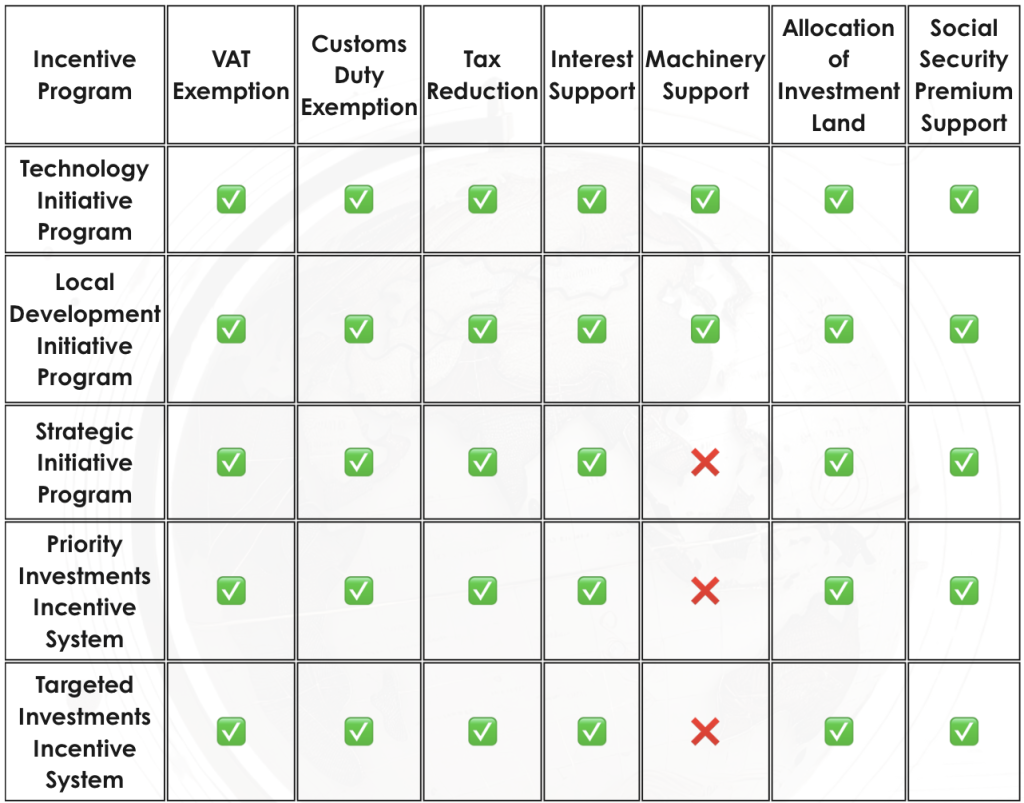
Note: Machinery support is only provided under the Technology and Local Development Initiative Programs.
Tax Reduction and Investment Contribution Rates
The tax reduction and investment contribution rates determined for each incentive program are as follows:
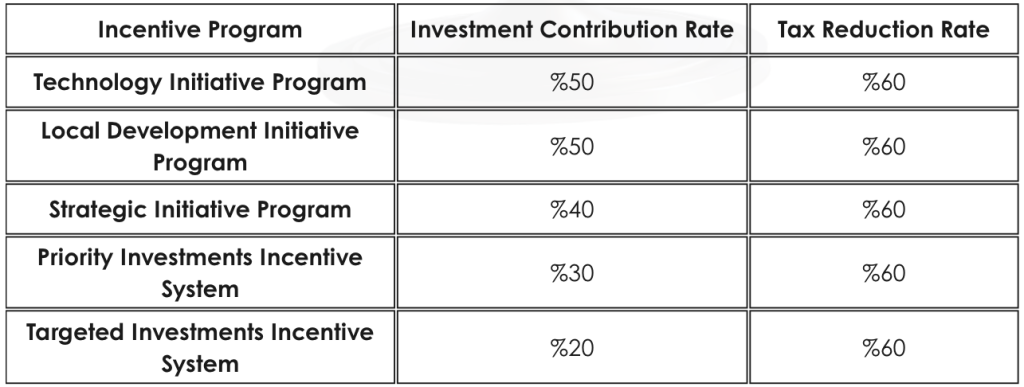
The investment contribution rate is 50% for both the Technology Initiative Program and the Local Development Initiative Program, 40% for the Strategic Initiative Program, 30% for the Priority Investments Incentive System and 20% for the Targeted Investments Incentive System. The tax reduction rate is 60% for all these programs.
The investment contribution rate indicates the extent to which the government will contribute to the total cost of the investment. The tax reduction rate, on the other hand, specifies the portion by which the tax payable on the income generated after the investment becomes operational will be reduced.
Limits for Interest and Machinery Support
The interest support and machinery support limits determined for each incentive program are as follows:
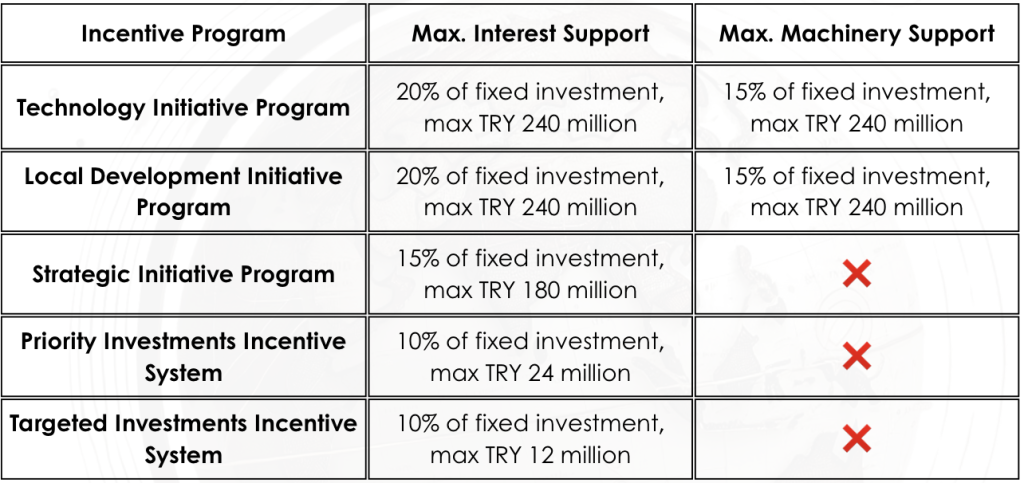
Note: Machinery support is only provided under the Technology and Local Development Initiative Programs.
Regional Incentives and Social Security Supports
Turkey is divided into six regions based on socio-economic development levels. Each region is entitled to different support instruments.
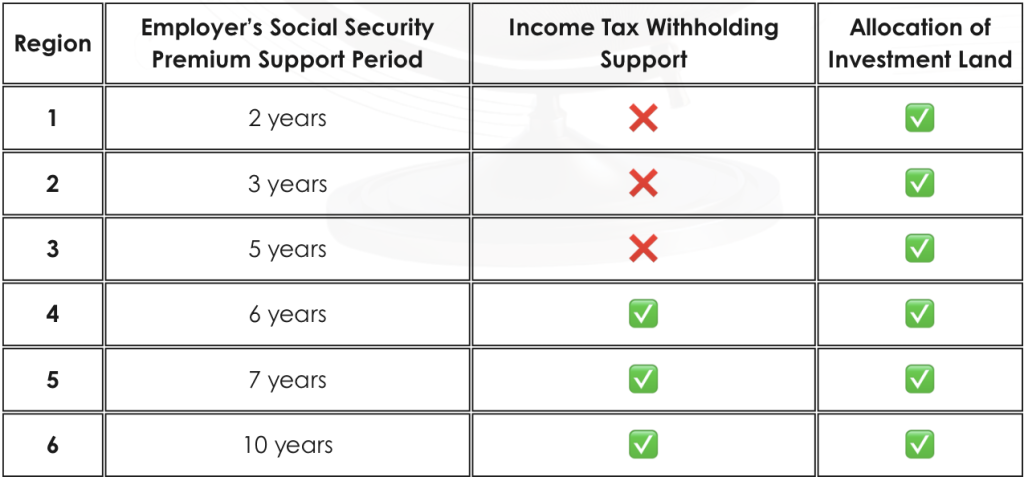
Note: Additional supports are provided for investments carried out in Region 6.
Implementation Calendar and Validity
This comprehensive regulation entered into force on 30 May 2025 and is expected to remain valid until 31 December 2030. Applications for investment incentive certificates will be evaluated until 31 December 2030.
Conclusion
The new investment incentive system offers a comprehensive and goal-oriented structure aimed at supporting Turkey’s economic development objectives. Prioritizing strategic, technological, and regional investments, the system presents significant opportunities for investors and seeks to promote balanced growth across the country.
For more information and application procedures, please contact us at info@cetinavukatlik.com or visit the official website of the Ministry of Industry and Technology.
To get detailed information about the services of our office on the subject:
For individuals or companies planning to relocate to or invest in Turkey, opening a bank account is often one of the initial steps. Although the process is relatively straightforward when the proper documents are in place, there are important distinctions between personal and corporate accounts, especially for foreign nationals and businesses. This guide outlines everything you need to know from required documentation to choosing the right financial institution.
Understanding Bank Accounts in Turkey
A bank account enables individuals and entities to perform key financial functions such as deposits, withdrawals, fund transfers, and bill payments through authorized banks. Banks in Turkey offer account opening services free of charge, although some transactions like electronic fund transfers (EFT) or international wire transfers may incur a fee. Maintaining an active account is part of the standard services banks provide to their clients.
Process of Opening a Personal Bank Account
To begin, choose a bank and a specific branch where you’d like to open your account. Anyone who submits the required paperwork can initiate this process. For minors under 18, parental consent is necessary. The typical documents requested include a valid ID or passport, proof of residence, and evidence of income. Depending on the bank, additional documents may also be required.
Thanks to digitalization, many banks in Turkey offer online platforms through which account openings can be initiated without visiting a branch.
Setting Up a Business Bank Account in Turkey
To open a corporate bank account, a business must first be legally registered in Turkey. Once incorporation is completed, the company becomes a legal entity separate from its shareholders. Business accounts are distinct from personal accounts and cannot be used interchangeably.
After establishing a company -whether it’s a limited liability company or a joint-stock company- an authorized representative can open a corporate bank account on behalf of the company. This requires a signature circular, and in certain cases, the presence or authorization of company directors as outlined in the articles of association.
Corporate bank accounts are vital not only for transactional ease but also for legal compliance.
Required documents generally include a tax certificate, ID of the representative, signature circular, and trade registry extracts. However, specifics may differ between banks and based on the legal structure of the company.
Bank Account Setup for Foreign Individuals
While the general procedure for foreigners is similar to that for Turkish nationals, some specific documentation is mandatory. Foreigners must present a valid passport, a Turkish tax identification number, and a correspondence address in Turkey. If the individual does not reside in Turkey, they must still provide a valid mailing address for official communications.
The tax number can be obtained from the local tax office by presenting the passport and other identifying documents. All information submitted must be up-to-date, especially the passport. Some banks may request further documentation, so it’s recommended to confirm these in advance.
Corporate Bank Accounts for Foreign-Owned Entities
Foreign companies or entities with foreign shareholders may also open corporate bank accounts in Turkey. The necessary documentation usually includes the company’s articles of association, registration and activity certificates, trade registry records, and relevant licenses or permits. All foreign-language documents must be translated into Turkish and notarized or certified by the Turkish consulate or authorized institutions.
Opening a corporate bank account may be a legal obligation in some sectors or a practical necessity in others. Foreign entrepreneurs planning to start a business in Turkey are strongly encouraged to open a corporate bank account as part of the incorporation process.
Choosing the Right Bank in Turkey
Selecting a bank involves evaluating various factors beyond the institution’s size. International transaction capabilities, customer service for foreign clients, digital banking tools, and branch accessibility are all important considerations.
- Public Banks (e.g., Ziraat Bank, VakıfBank, Halkbank): These institutions offer security and broad coverage, though their bureaucratic procedures may slow down the account opening process.
- Private Banks (e.g., İş Bankası, Yapı Kredi, Garanti BBVA, Akbank): Known for more streamlined procedures and advanced digital services, private banks often cater better to the needs of foreign investors, offering English-language support and quicker processing.
- Participation Banks (e.g., Kuveyt Türk, Albaraka Türk, Türkiye Finans): These banks operate under Islamic finance principles and may appeal to clients interested in interest-free banking models.
Foreign investors are advised to select banks based on their business sector, transaction needs, and expected volume. Some banks even allow account opening without being physically present in Turkey, subject to certain conditions. It’s best to confirm documentation requirements with the bank ahead of time and seek legal counsel if needed.
Frequently Asked Questions
How can I open a business bank account in Turkey?
To open a corporate bank account, you’ll need to visit the branch of your chosen bank. Shareholders must present passports, tax IDs, company incorporation documents, proof of address, and a power of attorney if the process is handled by a legal representative.
Which bank is most suitable for foreigners in Turkey?
The ideal bank depends on your specific needs. While public banks offer reliability and state backing, private banks typically provide more efficient service and better digital infrastructure. Participation banks are a good option for interest-free banking.
Can a foreigner open a bank account in Turkey?
Yes, foreigners can open accounts by presenting valid documents such as a passport, tax ID, and correspondence address. Requirements may vary across banks, so it’s important to check with the institution beforehand.
Is a business bank account legally required for companies in Turkey?
While not always mandated by law, business bank accounts are essential for compliance with financial regulations and smooth operation of a company’s activities.
Final Remarks
Opening a bank account in Turkey, whether personal or corporate, hinges on preparing and submitting the correct documentation. While legal obligations may not always require corporate accounts, in practice, they are indispensable for running a business. Foreign nationals aiming to start operations in Turkey are strongly advised to consult with a local business attorney to ensure compliance and facilitate a seamless setup process.
Should you wish to receive legal representation or consultancy services on these matters, either on an individual or corporate basis, please do not hesitate to contact with Cetin Attorney Partnership.
Av. Alper ÇETİN (alper@cetinavukatlik.com)
A joint stock company (JSC) in Turkey is a business structure where ownership is represented by shares, and shareholders are only accountable up to the value of their committed capital. This comprehensive guide outlines everything you need to know to establish a JSC in Turkey, from the foundational requirements to tax liabilities, capital rules, and shareholder dynamics.
Before proceeding, it is important to note that establishing a company in Turkey as a foreign national requires specialized expertise. Therefore, it is strongly recommended to work with a corporate lawyer based in Turkey at this stage. In this respect, Çetin Attorney Partnership provides the highest quality legal consultancy and attorney services throughout Turkey, primarily in İzmir and Istanbul, in a professional, corporate, and transparent manner.
If you have any questions or require legal support on this subject, feel free to reach out to us at info@cetinavukatlik.com.
Understanding Joint Stock Companies in the Turkish Legal System
Joint stock companies are legally defined under the Turkish Commercial Code as capital-based entities whose liabilities are limited to the corporate assets. JSCs can be formed by either individuals or legal entities, and there is no nationality restriction, foreigners can also incorporate them without the need for Turkish partners. While limited liability companies are more common, JSCs are often required in certain regulated sectors like finance, insurance, or publicly traded businesses.
In international terms, a Turkish JSC is similar to entities such as Corporations (Inc., Corp.), Societas Europaea (SE), Società per Azioni (SpA), Sociedad Anónima (S.A.), Aktiengesellschaft (AG) or Public Limited Companies (plc).
Legal Steps to Form a JSC in Turkey
A JSC can be founded for any lawful commercial activity. The first step is to draft the articles of association, which act as the company’s operational framework. This document must outline the company’s business purpose, capital structure, governance, and share-related provisions.
Once the articles are complete, they must be signed by the founders before an official at the Trade Registry Office. Afterward, the company is officially registered and announced in the Turkish Trade Registry Gazette, granting it legal entity status.
Minimum Capital Requirements and Share Structure
As of 2025, the minimum capital required to incorporate a JSC is 250.000-Turkish Lira. If opting into the registered capital system (frequently used by publicly traded companies), the initial capital must be at least 500.000-TRY.
Capital must be divided into shares, and this breakdown -including share types and nominal values- must be clearly stated in the articles of association. At least 25% of the subscribed capital must be paid in cash before registration, with the rest to be paid within 24 months. The timeline and method of payment can be predetermined in the articles or by a board decision.
Naming the Company: Trade Name Requirements
The trade name must be distinctive, reflect the business activity, and end with “Anonim Şirket” (JSC in Turkish). Before finalizing the name, a registry search is recommended to avoid duplication. The chosen name becomes the company’s legal identity and must be included in the articles of association.
Company Purpose, Scope, and Duration
The company’s purpose and field of operation must be clearly defined. Broad language can be used to allow flexibility for future expansion. In regulated sectors, specific language is often required such as in health tourism or financial services.
The articles must also state whether the company is established for a limited or indefinite term. If time-bound, an extension must be decided before expiry to avoid automatic termination.
Headquarters and Address Registration
The company’s headquarters must be declared during registration. This official address is recorded in the trade registry. If it changes, the update must be reported through a formal decision by the General Assembly. Companies not requiring a physical office can opt for a virtual address, provided it’s legally valid.
Who Can Establish a JSC in Turkey?
Only one founder (either an individual or a corporate entity) is sufficient to start a JSC in Turkey. There is no upper limit on the number of shareholders. Foreign nationals and foreign legal entities can freely establish companies under the same legal framework as Turkish citizens.
Foreign individual founders must complete extra steps, such as passport translation, obtaining a Turkish tax ID, and registering a power of attorney. If the founder is a foreign company, additional documents, including a resolution designating a representative and a trade registry extract, must be translated and submitted.
Governance Structure: Required Company Bodies
Turkish law mandates two governing bodies for JSCs:
- General Assembly: This includes all shareholders and decides on critical issues like capital changes, board elections, or dissolution.
- Board of Directors: Handles day-to-day operations and strategic decision-making. Members may be shareholders or external individuals.
While not obligatory, companies may also appoint an auditor to oversee financial practices.
Shareholder Rights and Transfer Rules
Shareholders enjoy financial rights (dividends), management participation (voting), and protection mechanisms like preemptive rights. These rights and obligations should be defined in the articles.
Shares can be:
- Registered: Linked to the owner’s identity, requiring documentation for transfer and registration in the share ledger.
- Bearer: Easily transferable through delivery of the certificate, though such transfers must be reported to the Central Securities Depository (CSD).
Preferred shares can grant superior rights in dividends, voting, or liquidation returns. Transfers may be limited by unpaid share capital or conditions in the articles of association.
Profit Distribution and Reserve Funds
The method of distributing profits, dividend ratios, payment timelines, and creation of legal reserves must be defined in the articles. Any conditions for reinvestment or retained earnings should also be specified to avoid conflicts among shareholders.
Representation and Signing Authority
The authority to legally represent the company typically rests with the Board of Directors unless delegated. These powers and any restrictions must be clearly outlined in the articles to define who can act and sign on behalf of the company.
Tax Responsibilities for Joint Stock Companies
Once incorporated, a JSC in Turkey becomes subject to several tax obligations:
1. Corporate Income Tax: Currently 25% on annual net profits.
2. Value Added Tax (VAT): Applied at 1%, 10%, or 20% depending on services or goods.
3. Withholding Tax: Applies to dividends, interest, or royalties and rates vary based on treaties.
4. Stamp Duty: Imposed on contracts and official documents.
5. Social Security Premiums: Employers contribute approximately 32.5%–37.5% of gross salaries.
6. Advance Taxes: Quarterly prepayments on estimated earnings are required.
Delays or errors in compliance may result in heavy penalties. Consulting a tax professional is highly advisable.
Share Types and Issuance
Shares in a JSC can be certified or uncertified. Uncertified (naked) shares are still valid but must be transferred via written assignment. Certified shares, whether registered or bearer, must follow legal transfer procedures to ensure validity and recognition.
Dissolution and Liquidation Procedures
A JSC may be dissolved under the following conditions:
- Expiration of its term (if defined)
- Impossibility of fulfilling its purpose
- Bankruptcy
- Voluntary decision by the General Assembly
- Other legal or statutory conditions
Upon dissolution, the company enters liquidation, and “in liquidation” is added to its name. Liquidators (appointed in the articles or by General Assembly) handle the process, which includes asset review, debt payments, and distribution of remaining funds.
Liquidation concludes when the liquidator requests the removal of the company’s name from the registry. Records must be kept for at least ten years after closure.
Conclusion
The process of registering a joint-stock company in Turkey remains one of the most commonly inquired topics among entrepreneurs seeking to establish this type of entity. As capital companies governed by the Turkish Commercial Code, joint-stock companies represent the second most frequently formed legal structure in the country. Certain business sectors are exclusively accessible through joint-stock companies, and the transfer of shares in such entities is generally more straightforward than in limited liability companies. A joint-stock company can be founded by a single individual whether a Turkish citizen or a foreign national or by multiple shareholders, provided that the minimum capital requirement of 250.000-TL is met. To ensure legal compliance and clarity, the articles of association which function as the company’s foundational charter should be drafted with professional legal assistance.
This article contains the assessments made within the framework of the legislation in 2025. Please do not hesitate to contact us for information about limited liability companies, agencies, branches and other investment opportunities.
Following applications to the Constitutional Court by local courts and higher courts, claiming that Article 27, clause 1 and 2 of Law No. 5718 on Private International Law and Procedural Law (“PLCPL”) are unconstitutional in lawsuits arising from employment contracts, the Constitutional Court examined the applications and, in its decision numbered 2023/158 E. and 2024/187 K., found clause 1 of Article 27 of PLCPL to be unconstitutional under Article 49 of the Constitution, thus annulling it. However, it deemed clause 2 to be in accordance with the Constitution and rejected the annulment request. The annulment decision was published in the Official Gazette on March 10, 2025, and will come into effect after a six-month transition period, on September 10, 2025.
Annulled and Maintained Provisions
The annulled clause (1) of Article 27 of the PLCL stipulated that the law chosen by the parties would apply to employment contracts, but the minimum protection provided by the mandatory provisions of the law of the employee’s habitual place of work would be preserved. The Constitutional Court, considering the possibility that the freedom of choice of law may lead to unfavorable consequences for the employee, found this provision contrary to Article 49 of the Constitution and decided to annul it.
Clause (2), on the other hand, regulates that in employment contracts with a foreign element, if the parties have not made a choice of law, the law of the workplace where the employee habitually performs his/her work will be applied and the fact that the employee temporarily performs his/her work in another country will not make this workplace a habitual workplace. The Constitutional Court ruled that this regulation is within the scope of the discretionary power of the legislator and that the judge may act in accordance with law and equity in determining the law of the habitual workplace and that it is not contrary to the Constitution.
Grounds for the Annulment Decision
The Constitutional Court, by evaluating the limits of choice of law in employment contracts and the principle of employee protection in detail, based its decision to annul paragraph (1) of Article 27 of the PLCL on the following grounds:
1. The Risk of Preventing the Employee from Benefiting from the Law Providing Stronger Protection
The Constitutional Court identified the risk that if the law applicable to the employment contract is determined by the choice of the parties, the law to which the employment relationship is more closely bound may be excluded. In scenarios where there is no choice of law, it is possible that another law that may provide higher standards of protection for the employee may come into action, whereas the current regulation limits this possibility. This may lead to the elimination of legal safeguards that may be more advantageous for the worker.
2. Limitation of the Bargaining Power of the Employee
The Constitutional Court considered that the bargaining power of the employee against the employer is generally limited and that the employer is likely to choose a more advantageous law when choosing a law. The possibility of the employee being deprived of the protections provided by a law that is more closely related to the employment contract and provides him/her with higher protection has been one of the important grounds for the annulment decision.
3. Unpredictability of the Content of Foreign Law
The inability of employees to foresee the content of the foreign law and to determine whether the application of this law is in their favor may lead to a disadvantageous situation for the employee. The Constitutional Court emphasized that in a technical field such as labor law, even judges have difficulty in determining the content of the foreign law, and therefore it is almost impossible for employees to obtain sufficient information and foresee the possible consequences. It has been stated that there is a high probability that employees may make wrong choices due to the choice of law and thus be deprived of a legal regime in which they could actually be better protected.
Conclusion and Implementation Process
Emphasizing the state’s positive obligations to protect workers, the Constitutional Court ruled for the annulment of Article 27, clause (1). The relevant regulation will enter into force on September 10, 2025. However, clause (2), which provides for the application of the law of the employee’s habitual place of work to employment contracts in scenarios where employees and employers do not have a choice of law, will remain in force. The Constitutional Court stated that the determination of the law of the habitual place of work is within the discretionary power of the legislator and that the judge may make an assessment in accordance with the law and equity and found this provision to be in accordance with the Constitution.
This decision is an important milestone in terms of the applicable law in contractual relations between employees and employers. For employers, it underscores the necessity of considering minimum standards that protect workers. For employees, it highlights the need for awareness regarding the potential risk of losing access to more favorable legal regimes. Particularly in international employment contracts, it is crucial for parties to exercise caution when choosing the applicable law and to ensure adequate legal safeguards in their agreements.
Av. Gül ACAR (gul@cetinavukatlik.com)
Av. Alper ÇETİN (alper@cetinavukatlik.com)
For detailed information regarding our office’s services on this matter: